The spring and early summer of 1973 passed by in a haze of hard and at times brutal work, with brief respite trips to London and a five week hitch-hiking sojourn to Denmark and back. Having surpassed my own low expectations by being offered a place on a Diploma in Communication Studies course at the Polytechnic of Central London in the autumn I set about getting myself my first job in England.
I moved to the Surrey town of Farnham, where my sister Jane was a textile art student and I found myself a tiny room to rent for £8 a week. Work came in the form of a job as a yard labourer at the firm of W.C.Ware & Sons on the Farnham Trading Estate. This was my harsh introduction to the world of work. A tough environment where I was expected to shift lengths of wood on my shoulder from place to place. The foreman was a brute, a former squaddie called Scouser Barry who particularly enjoyed headbutting anyone he didn’t like. Eventually he went too far and was escorted off the premises. I would walk home with splinters in my hands and sometimes in my neck. The concepts of protection and safety were far from anyone’s minds in 1973. Friday lunchtimes we were straight down the pub, but I did strike up an unlikely friendship with a young biker rocker called Sean. One particular memory was a three day job in nearby Guildford at another branch where I and one other were sent to pick up and sort out a giant bundle of lengths of wood that had fallen over. Giant pick-up sticks came to mind.
For music I had a small cassette player and I was listening to Lou Reed’s Transformer and Bowie’s Hunky Dory and much more as well as a lot of Radio 1 at the time. The house next door were friendly and I remember going with a couple of them to a windowless flat in Kensington to ‘score’ some consumables. I think the guy in the flat was the prototype for Presuming Ed, the dealer with the giant Afro in the film Withnail & I. I think I passed out after inhaling a few puffs.
I had saved enough money from the job at the timber yard to make the trip to Denmark with a local friend called Andrew, who like me was 18. He was half Danish and had some family members living there. We hitched to Dover, mostly in big trucks and got on a ferry to Ostend and arrived around midnight. We looked around in the dark for a park to pitch our tent and found what appeared to be one and scrambled over a low wall. In the morning we were woken up by a military guard and found ourselves in the grounds of a royal palace in Ostend and were swiftly escorted from the grounds with a flea in our ears. It took three whole days to reach Roskilde in Denmark travelling through Belgium, the Netherlands and West Germany. Many boring hours were spent at the side of the road, but there were moments of kindness when people helped us out. Sleeping on the side of the road with just a sleeping bag was not a great experience, although I remember one night in Holland we bunked off into the woods and set up the tent. It was a relief to get to our destination after three days and stay in a friends garden nearby in our little tent. Denmark was full of Vikings, expensive beer and free festivals. (The first Roskilde festival where someone was handing out free beers and a lot of psychedelic blues. ) I didn’t know it at the time but this was my last year of eating meat and I indulged in a few of Copenhagen’s famous hot dogs at Tivoli Gardens with perennial wasps buzzing around. It was a surreal and carefree summer. To be continued…
Like a sneaky fugitive I managed to skip away from the clutches of the encroaching arms of the security forces by boarding a flight in Salisbury to London, via Lisbon, on a TAP flight, in April 1973. I remember seeing the shiny boots of a Police Officer at the airport and then to my horror realized that they belonged to a former school colleague from just three months before, whose name I can still remember, a white farmer’s son called Ian Darby. I managed to sneak around him as I had an irrational fear that he would have stopped me boarding that plane.
This was Rhodesia just as the guerrilla war for independence was hotting up and I knew I wanted to play no part in that by fighting for the continuation of white supremacy under the Ian Smith regime. I was just 18 and had recently left school with three low grade ‘A’ levels in History, English and Geography. Just two weeks later an army detail visited my parents house in Salisbury, (now Harare) looking for me to be conscripted immediately. It was a narrow escape. My Mum told them “You’re too late, he’s gone.” They left disappointed. My compass was pulling me strongly towards the UK.
London was an exciting place to land, it was April and much cooler than I was expecting, I really didn’t have the right clothes for an English spring. Somewhere near Shepherd’s Bush I spent my first couple of weeks, staying with an aunt. My sister Jane was around too and I clearly remember her taking me to my first London gig, in a pub nearby with South African jazzman Dudu Pukwana supported by maverick sax player Lol Coxhill. I felt free for perhaps the first time as an adult. The next day I was introduced to the film work of Jacques Tati and his automobile and his world of visual humour – Trafic. Life had begun in a new place and there was a new exciting world to discover. To be continued…
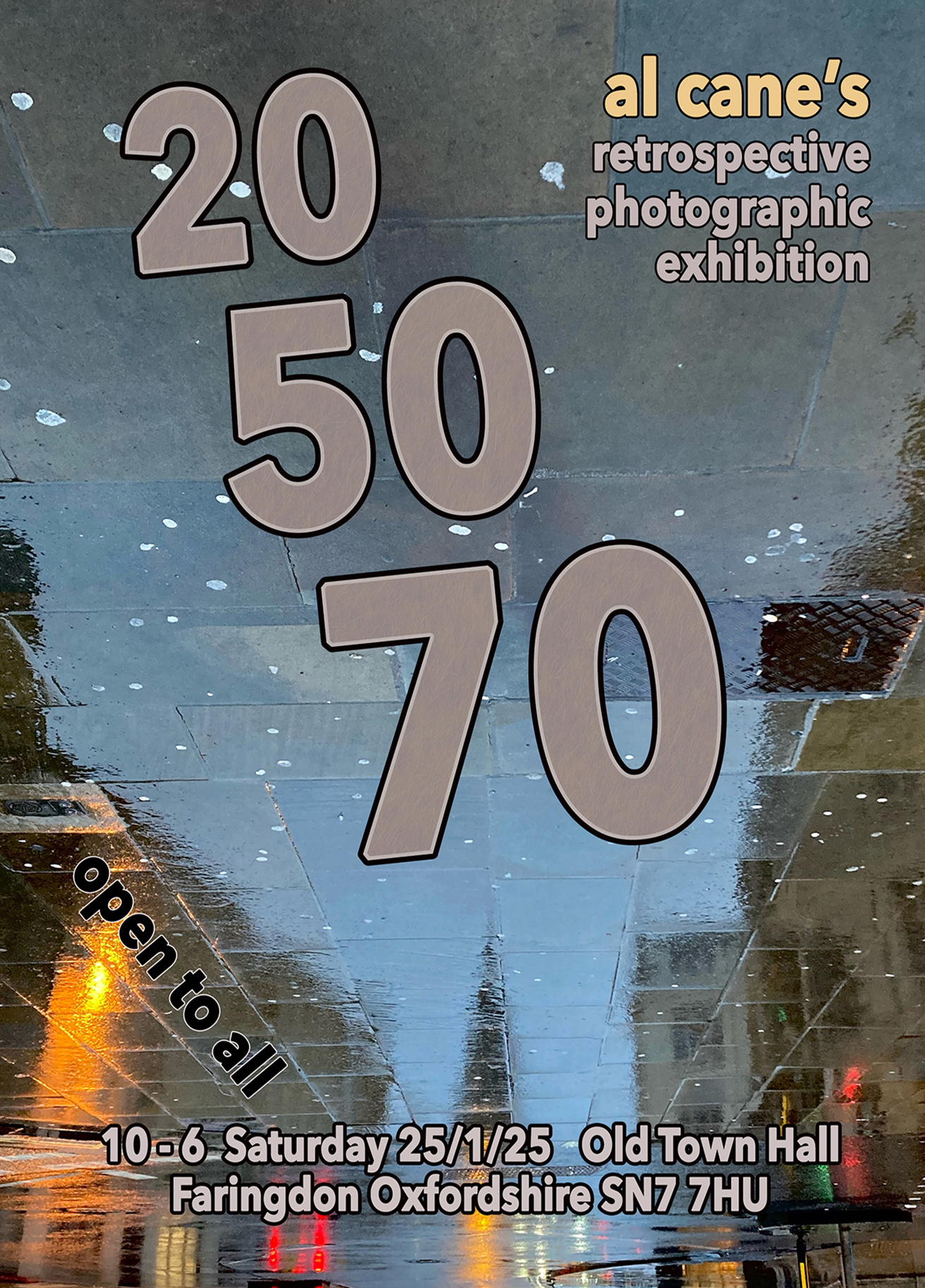
Some of you may be aware I’ve reached a major event in my life, which is to hold a solo photo exhibition for the first time in almost 30 years, as well as celebrating a significant birthday.
I’ve titled it 20 50 70.
The 20 stands for the number of years my partner Helen and our daughter Anna and I have lived in this funny, old town called Faringdon in Oxfordshire.
The 50 stands for three things, approximately the number of photographs in this show, 50 years since I gave up eating meat, (inspired by G.B.Shaw’s vegetarian cookbook and a former housemate called Ken) and thirdly it is exactly 50 years since I emigrated to the USA, which was a major turning point in my life.
The 70 is there because it sums up the total of the first two and also reflects the number of years I’ve been around. It’s a very small number in the scheme of things.
It’s retrospective, it has to be. Where do I begin? With my sight of Victoria Falls as a ten year old armed with a Kodak Brownie camera and black and white film or later on as an adult after getting to grips with my first darkroom in the basement of the Polytechnic of Central London in Regent Street in the early 1970s. It took me a long time to get the hang of photography, nothing is ever completely finished, there’s always more to look at. My first black and white experiments were very haphazard, a lot of grainy prints ensued. But I did have a lot of encouragement to carry on.
Travel photography, political journalism, musical performances, abstract, nature, reflections, moons and more. I’m not the kind of person who sits in a field for several hours waiting for the perfect moment.
It was hard to narrow it down, even now I think why did I choose this over that?
There are also four short episodes with photographs from my previous life – from the USA, Zimbabwe, Nicaragua and Estonia.
I’d like to cover my costs first of all but over and above that I’d like to raise some funds for two causes that mean a lot to me. The first is a local charity called COGS (Community Owned Guidance Service), a project born out of the Pump House Project here in Faringdon who provide discreet support and guidance for young people in this area aged between 15 and 24. Mental health support is such a key issue.
thepumphouseproject.org.uk/cogs/
The second cause is to help provide some support for Medical Aid for Palestinians (MAP). The situation facing innocent people in Gaza and the West Bank is desperate and with the intentional destruction of medical facilities just makes it appalling. Last year I rode over 200 miles for MAP and friends were kind enough to support me for over £1000. This is humanitarian aid.
The plan is to sell prints if there is interest, some are from original negatives (pre 2005) and others are digital images (post 2005). All the photos are numbered for ease of identifying. They can all be printed again to a specified size. Then there are already printed up greetings card and postcards too.
Please leave a comment if you feel like it. Thank you.
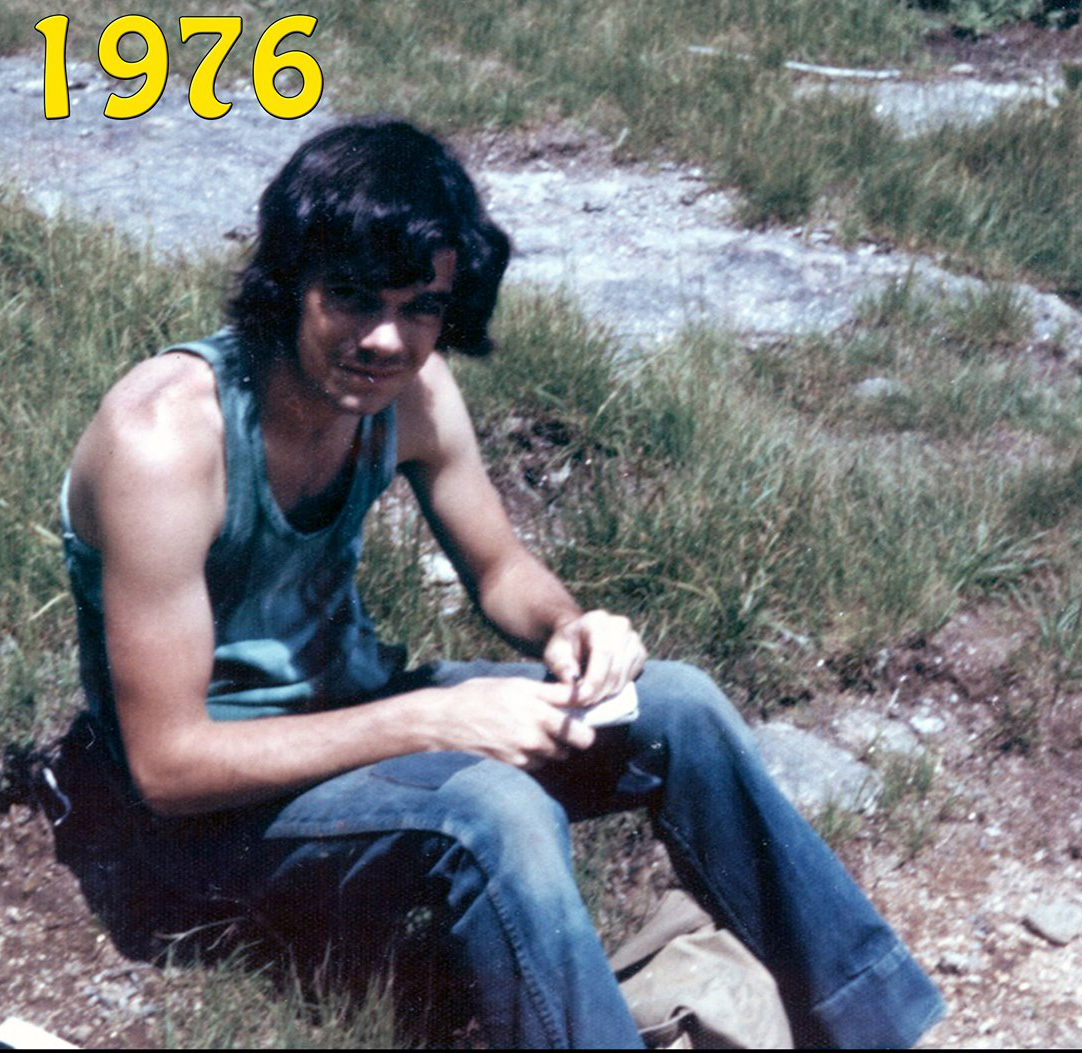
My USA road trip diary begins on Thursday 15 July 1976, I had turned 21 that January and had arrived in New York from London the previous August. I lived in Goshen, New York with my then American wife Kris and her family. These are extracts from my recently turned up diary of the road trip.
* An explanatory note for clarification for anyone reading this. In early 75 I was living and studying in London where I met and later married Kris, short for Kristyne, in Fulham Registry Office (cost £8). The main reason for this marriage of convenience, although we did live together, was that I had a desire to live in the USA, despite never having been there. I applied for a Green Card and went through the strict and cumbersome process at the US Embassy in Grosvenor Square. Chest X- Ray for TB was produced, I had to swear I wasn’t a Communist looking to overthrow the US Government and they also did their background checks on me and even sent a local agent to what was then then Rhodesia, (where I had spent most of my childhood) to interview my Dad about my political background. Not a lot to report on there at that time.
We eventually landed in at JFK New York in August 75 and I found myself living in the family home in Goshen, New York. I didn’t get on at all well with Kris’s parents, second generation Polish immigrants on both sides, they were proto Reaganites who because I was from the UK thought I was a Communist or a Socialist at the very least and quite dangerous too. But I did manage to get a couple of jobs both house painting and worked in a warehouse.
My artistic sister Jane, who was living in Bristol at the time, proposed a summer visit with Chris, her then boyfriend, also from Bristol, a music enthusiast and mobile DJ. I welcomed the opportunity to escape. I had my heart set on California. Soon after they arrived the journey began and the day we drove out of Goshen we left a flourishing vegetable garden behind. I never saw Kris’s parents again and left it far behind.
Taken somewhere near the beginning of the journe
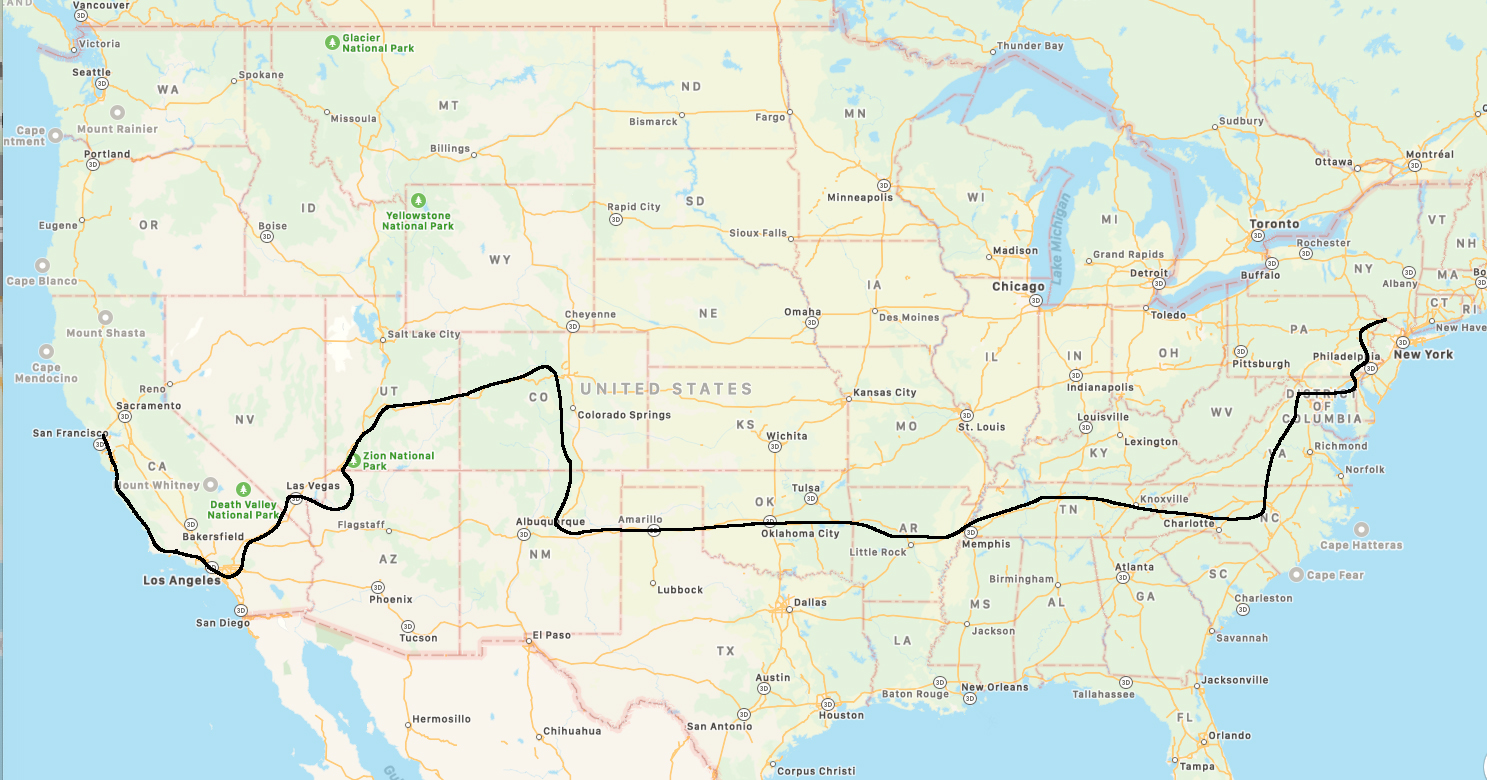
Approximate route taken, about 6000 miles over six weeks, mid July to the end of August 1976.
Part 1 New York to Pennsylvania
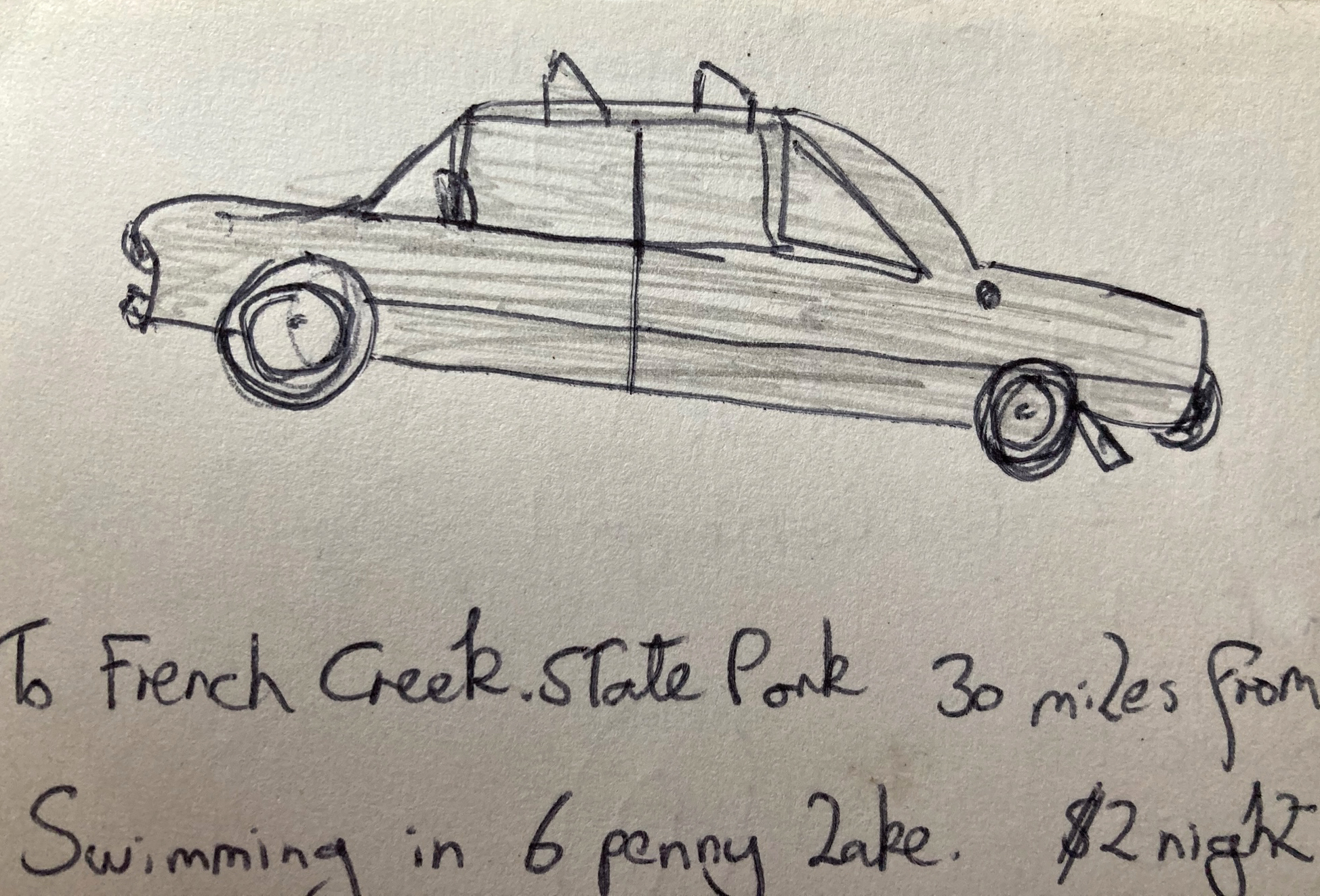
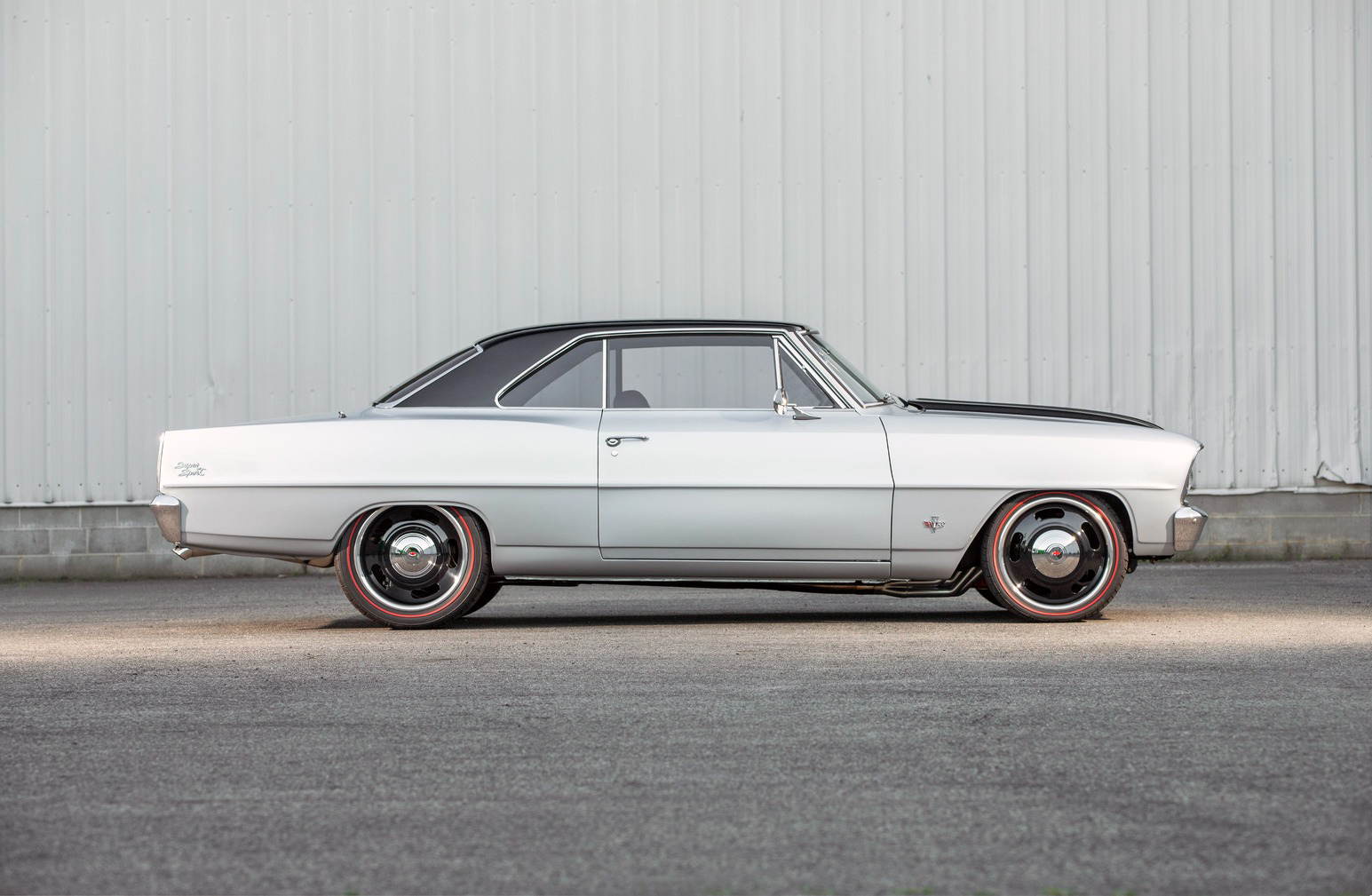
I had been living in upstate New York in Goshen for the best part of a year with my then American wife Kristyne. This was in Orange County near to Middletown and Newburgh, not far from the Hudson River. I escaped to New York City many times, which was only an hour away by bus and enjoyed cruising around Greenwich Village soaking up the atmosphere, doing some tourist things, reading the Village Voice every week. The City was in a state of decline and near bankruptcy then. (Think 1970s Taxi Driver and you get the picture.) The land of Goshen in reality was a dinky little conservative town with possibly two traffic lights, but it was where I passed my New York State driving test. There was a silver 10 year old Chevy Nova parked up nearby that someone was trying to get rid of, I gave them a nominal $1 for it and drove it away. It needed some work to get it roadworthy and the engine had a distinctive tapping noise too, which I never fixed. I couldn’t wait to get out of there and head for California so when my job in a warehouse in Lloyds department store in nearby Middletown came to an end and when my sister Jane and her then boyfriend Chris arrived to visit for the summer I thought here’s my chance. All four of us packed up and climbed into the two door Chevy and away we went heading south into New Jersey. My diary tells me our first night was at a place called Succasunna at the home of Kris’s cousin Lisa and her husband Gary. I liked them. We all went out to a nearby bar to drink Molson Ale and eat rye biscuits. I found Penny, the family Alsatian, lying on my bed in the morning when I woke. We ventured over to Charlie’s Happy Motoring Shop for some essential repairs where a screw was put into the gas tank to seal a small hole and 6 inches was cut off the tailpipe to stop it dragging on the ground, it was now a low slung car with our combined weight. We kissed those cousins goodbye, and sadly never saw them again, and we drove through rain and drizzle onto Route 80, we were finally on the first stage of our way to California. We were in The Poconos, Vacationland USA and our first night was camping at a place called Hickory Run State park where the camping fee was $3. The evening meal was red beans and rice and we dreamed of Philadelphia. The car only had an AM radio but we did have a battery powered portable cassette machine which to play ‘our’ music. Driving through Penn Dutch country we couldn’t help but see the hex signs painted on barns and landed at French Creek State park just 30 miles from Philly. A cooling swim on a hot day in Six Penny Lake and we were close to Daniel Boone’s homestead…
My very crude sketch of the Chevy from a page of the diary.
Part 2. Pennsylvania to DC
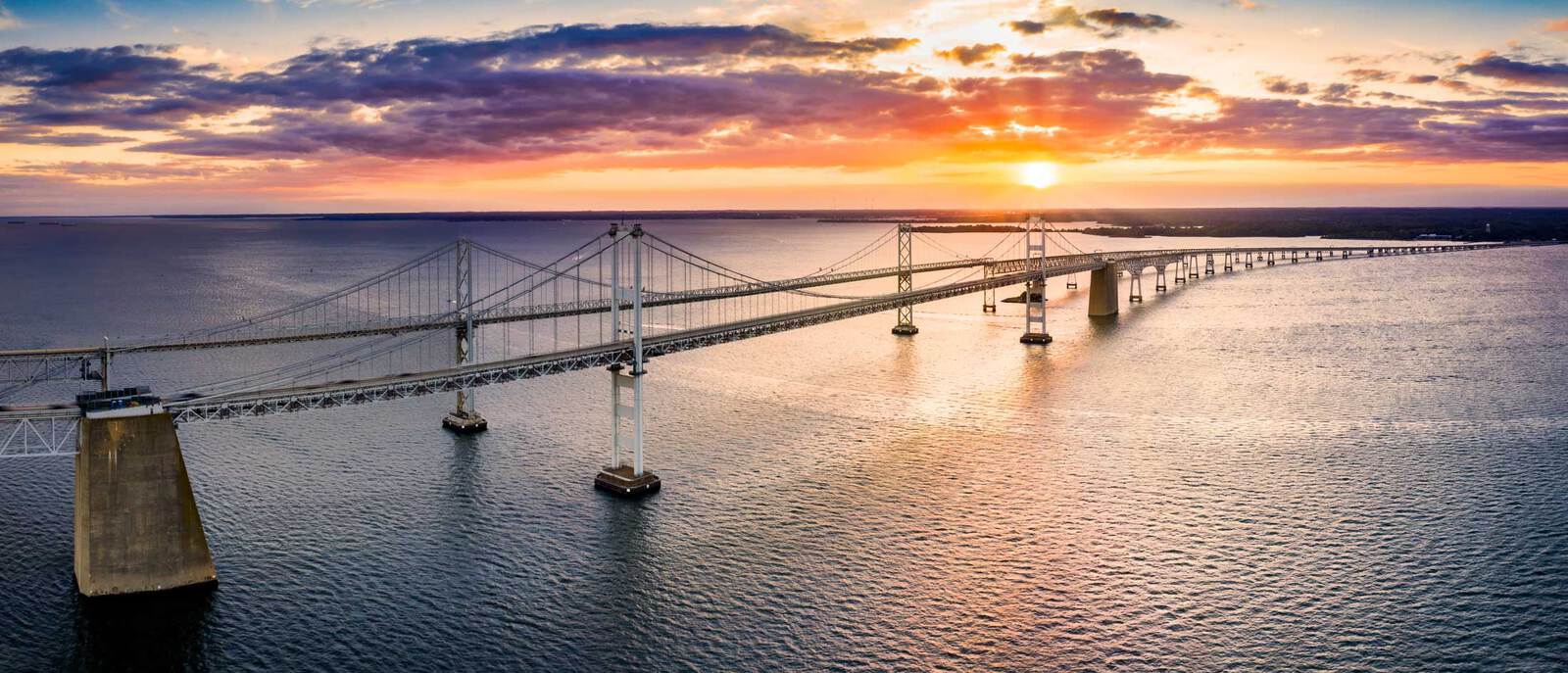
Before we got to Philadelphia there was more car trouble. My diary tells me that the Chevy’s radiator boiled over three times before we got there, which meant pulling over to cool it all down, before it happened again. We must have fixed the problem because there’s no further mention of it after this. Still ‘gas’ was at the time around 50 cents a US gallon. The diary is noticeably slim on entries when it comes to Philly, cradle of the Revolution, exactly 200 years before, and definitely Bicentennial City and it was certainly bedecked in swathes of red, white and blue everywhere. The Bicentennial had infested every single flagpole, garbage can and baseball cap in sight. There was a character playing Benjamin Franklin in the streets around the famous Liberty Bell. We also passed a park where a game of cricket was being played, we thought it odd. But there it ends that’s all I’ve got from the city that gave us some extraordinary music over the years but in 1976 it was the Brothers Johnson, Candi Staton, Wings, Hall and Oates, The Steve Miller Band and Thin Lizzy amongst others playing in rotation on the AM radio we had in the car, when we weren’t tuning into a preacher shouting at us and asking us if we had been saved yet? (The answer was no, still haven’t, most unlikely now.) We were two couples, Jane and Chris, Kris and myself, moving along in close company in the car, three of us were drivers, so we shared that and pitched our two tents at night at the various campsites we stopped at with a fairly primitive camping stove too. But there were occasionally points of tension and friction that mostly seemed to be around food. Passing through southern Pennsylvania we entered the state of Delaware and landed at Lums Pond State Park where they charged us $4 for the night, our most expensive night so far. We saw many turtles in the pond and swam there in the morning amongst the fish. (It says here.) The sun was out and it was warm so I remember staying here an extra day getting bronzed by the sun and reading the Herman Hesse novel Narcissus and Goldmund. We entered the state of Maryland and soon were crossing the two mile bridge over Chesapeake Bay towards Washington DC but by-passed Annapolis, home of recently disgraced former Vice President Spiro Agnew and Superman. (Both incorrect, Agnew was from Baltimore and Superman from the planet Krypton but that’s what I wrote down at the time.) We had only travelled 300 miles in 4 days!
The Chesapeake Bay Bridge. Contemporary photograph.
Part 3 . No. 3 DC to Virginia
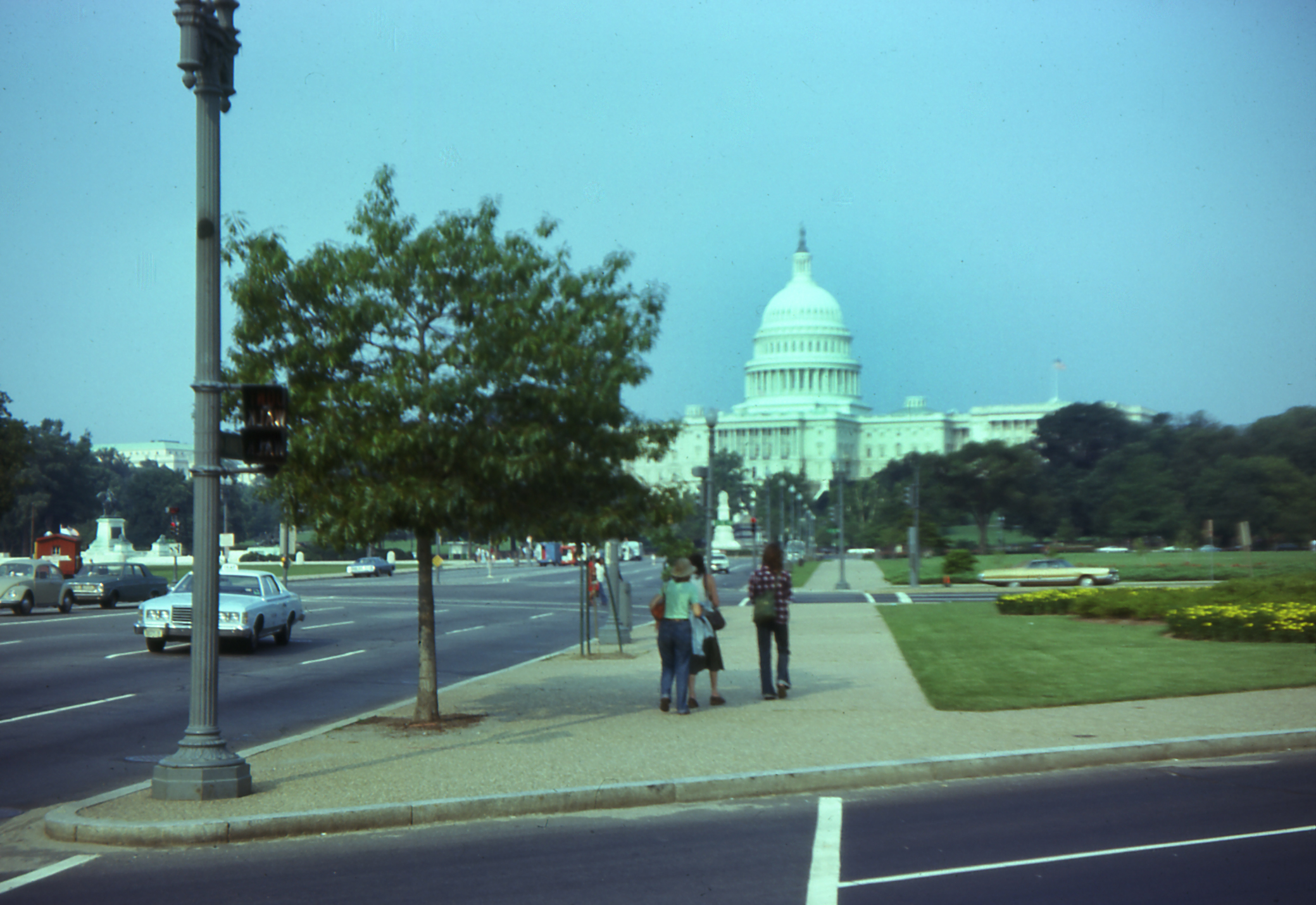
Entering the District of Columbia on a swelteringly humid summer’s afternoon we headed straight for the Greenbelt Federal Park for a couple of nights camping, this was only $2 a night for a pitch at the time. To get into the city we caught a shuttle bus from nearby RFK stadium and immediately dived in and lost ourselves amongst the enormous and extensive displays inside the world famous Smithsonian Museum for a few hours. Fascinating and absorbing to learn about different cultures – Pacific, Asian, African and indigenous as well as the Ice Age. (I wonder how it is now, very different I’m sure). I always have a problem with places like this, they are just too big these vast palaces of images, artefacts and information, I run out of energy before I’ve had my fill. I regret not spending longer there and in other nearby museums, but four people all in their early twenties wanted to get a move on. Washington DC, as is well known, has a split personality – on one hand there’s the Federal district with its White House, Capitol, Supreme Court and all its monuments and museums to famous people, presidents and pieces of history and then in complete contrast there’s the overwhelmingly Black Washington. Two worlds apart. We stood under the giant figure of Lincoln sitting on his giant chair looking out, strolled along Constitution Avenue past the Washington Monument and stared into the reflecting pool outside the front of the White House, but it was not a still day so the reflection was not to be seen. Gerald Ford was the then incumbent, to be turfed out by Jimmy Carter later in the year. A quick stop at Famous Luigi’s for Pizza lunch. (Google maps tells me this is now permanently closed.) Onwards to the Renwick Museum, connected to the Smithsonian, for an exhibition of symbols and signs of American life – streets, homes and the corporate world. For some forgotten reason we went on a futile bus trip to Fort Belvoir and back, something to do with the US Army. Eventually we made our way back to RFK stadium and to our car parked up to return to the campsite, shattered and exhausted and with some bickering between the two couples after a long hot day’s sightseeing. The next day, which was a Wednesday, we drove onto the beltway westwards towards Vienna, Virginia and having stopped to make some emergency repairs to the hose clamp on that troublesome Chevy again, filled up with provisions from a road stop called MacGruders. Finally we got onto the famous Skyline Drive through the Shenandoah National Park and 105 miles of mountains with camper vans aplenty and many signs warning of wild animals about. This was a beautiful trouble free drive and we were able to drink in the stunning views and scenery and really begin to enjoy ourselves heading south through Virginia and after that into North Carolina.
Photo shows Kris, Jane and Chris walking towards the Capitol.
Below is a found image of the 66 Chevy Nova, right colour but ours looked a bit rougher and had some rust creeping in.
Part 4. North Carolina at last
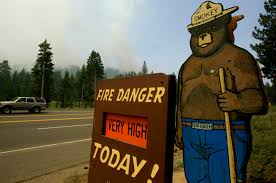
Leaving the nation’s capital behind us in the rear view mirror of our sometimes misfiring Chevy we cruised along Skyline Drive in rural Virginia on a misty, hazy day and came to rest at the end of it at a place called Goodwin State, we had a swim in the lake and stayed there the night and in the morning took a cool shower before the temperature climbed into the 90s. A diary entry read ‘We missed the smokey bears’. (I couldn’t recall the context so had to research it. Smokey the Bear was the face of the then federal government’s aggressive wildfire suppression policy.)
We, the not always happy foursome, were now a week and seven states into our odyssey across the USA and beginning to stretch out and enjoy it. The weather was really muggy in rural Virginia, tobacco country too, and we parked up at Occoneechee State Park on a massive reservoir. I also read there the tragic story of the Occoneechee people who were massacred by Nathaniel Bacon’s rebellion in 1676 near Roanoke on the borders of Virginia and North Carolina.
The insects were getting bigger the further south we travelled. By chance our next stop was at Buggs Island Lake and campsite, well named for the sound of the massive insect orchestra that played every evening, no doubt with a huge contingent of cicadas adding their voices. But this was a good place to swim and relax in the humidity. It appeared that we all got on well here and knuckled down to playing games of pinochle. No mention of drinking much, but there must have been the occasional cold beer downed, (you certainly wouldn’t want warm American beer.) I made a note to myself to take more photographs, something I failed to heed, except for a few slides taken here and there. At this point the Chevy was running fine apart from the muffler banging away, surely it wouldn’t last? The Voice of God or even Jesus was preaching again on the radio airwaves, anything for a bit of change from the never ending cycle of mostly inane 1976 pop hits interspersed with travel and weather reports and crazy ads.
We rocked and rolled into Raleigh, North Carolina on Friday 23 July looked for an elusive contact called Martin, a friend of Chris’s from Bristol who lived there. One of his flatmates called Norm entertained us and talks our ears off, but he had a great sense of humour. Norm was a wannabe musician who worked in a piano shop and told us he was wanting to start a band called Madness. (Not that one!) It took us a while to adjust to the accents of the people we met in Raleigh, but we did. My diary notes that we frequented a place called Blimpies for beer and sandwiches, a quart of beer was 68 cents at the time! We listened to some Zappa, smoke some green grass and did our washing at the campus launderette. I think this was in the middle of a student dominated district of Raleigh’s close by the North Carolina SU campus. Some locals saw our New York plates and shouted ‘What you doin’ here Yankees?’ Little did they know were were 75% British.
The midnight movie that Saturday was Robert Altman’s 1975 smash Nashville, as we were going to be there in the next few days it seemed like a good film to check out and for the price of one dollar entrance. Lily Tomlin, Ned Beatty and Shelley Duvall stood out at the time. I loved its satire and somehow being here in the South for the first time was beginning to make sense. We all much enjoyed the hospitality given to us by our new found friends in Raleigh and stayed in their spare rooms for three nights and will never forget Norm and his synthesizer project Madness. (Sadly I never got to hear the music as we lost touch.)
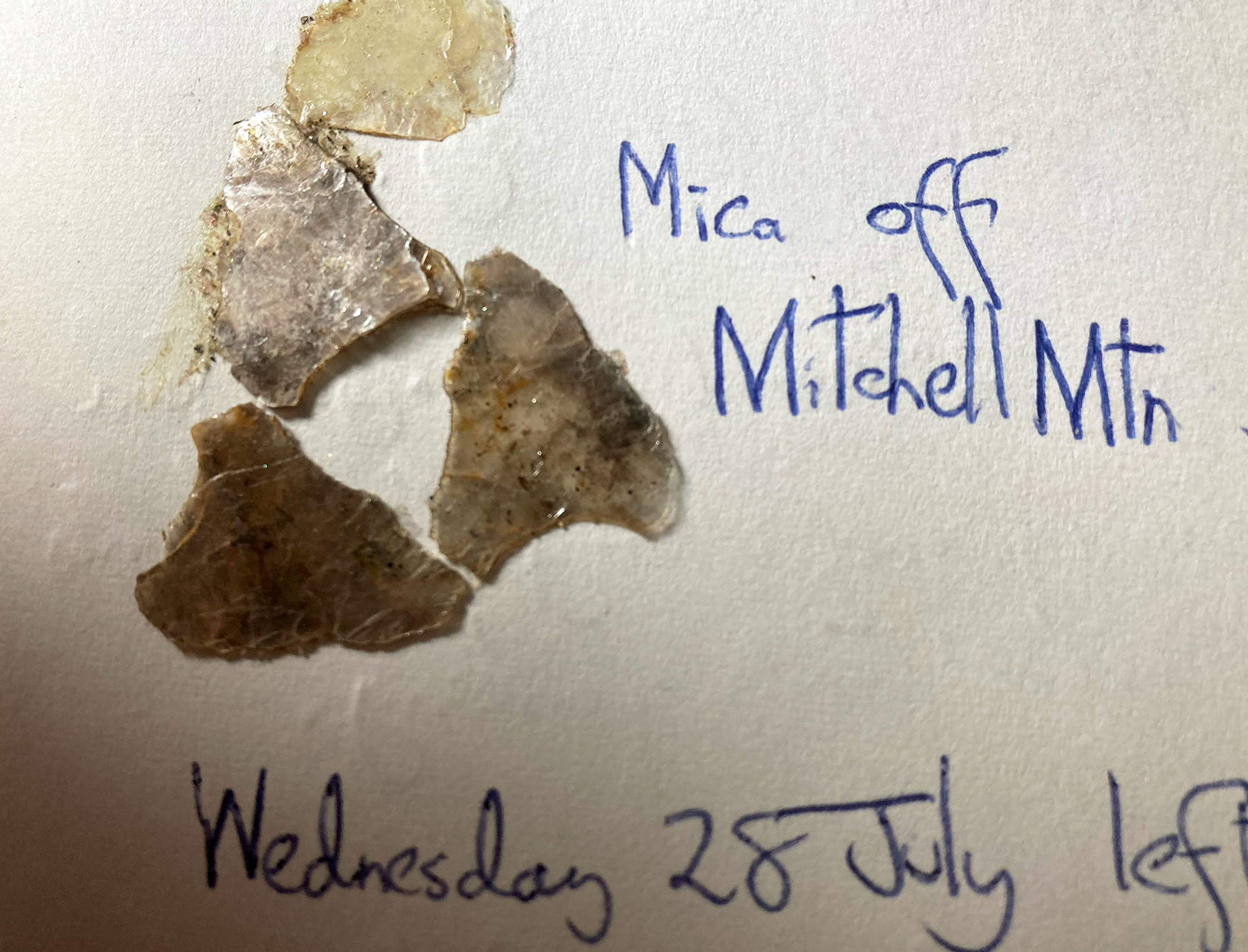
On the Monday we headed for the Smokey Mountains via Chapel Hill and Winston Salem having filled up with high test gas, the mileage read 64865, not sure why I wrote that down. We reached the Smokies and aimed for Mitchell Mountain at just under 7000 feet the highest point in the Appalachians and east of the Mississippi. An example of the mica from the mountain is glued into my diary, pictured here.
We appeared to have camped at a place called appropriately Black Mountain. The next day for some strange reason we visited the RJ Reynolds factory at Winston Salem to look at the Camels. (Did I even smoke at the time?) Close to leaving North Carolina – one further note the day’s petrol input was $13 and our V8 engine was guzzling gas at 15 miles per gallon.
Mount Mitchell view – contemporary image.
Part 5. Tennessee – a crash in Pigeon Forge
On Wednesday 28 July we left Black Mountain behind and crawled towards Asheville heading for the Great Smoky Mountains National Park. Wonderful rolling scenic views and pine trees spoilt later by blighted roadside commercialism through Gatlinburg and Pigeon Forge. We had just partaken of buckwheat pancakes at Joe’s Pancake House when things came to an abrupt stop in Pigeon Forge when our erstwhile driver, Kris, panicked in traffic, lost control and we were sideswiped by a Ford Motor Home and came to a halt only a few feet from a riverbank. Wheel flattened and fender and headlight gone. A State Trooper called Fred attended, sorted out everyone, no-one injured just a bit shocked. He was more taken with us being from the UK and talked incessantly about his model railway passion! We put the spare tyre on somehow and crawled to a nearby campsite for the night, stopping to buy a few beers on the way.
The next morning we sought out a giant scrap yard – Raceway Auto Parts Inc of Seiverville and spent three hours there locating a comparable Chevy model (of a different colour) and found a fender, headlight and mudguard. They helped us bang the car back into shape, align the wheels and charged us a princely $100 and we were just about roadworthy as we headed off into deepest Tennessee through Knoxville and landed at Cumberland State Park for a night of camping. Nashville and its pickin’ parlours awaited.
Part 6. Nashville and its pickin’ parlours
We left the bad memories of the car crash behind in East Tennessee, but not before the tent had collapsed on our heads in the middle of the night, and headed west in our now silver and blue Chevy towards Nashville. We were four cramped in our car with tents, sleeping bags and a primitive camping stove. With only an AM radio in the car for entertainment! We drove on to the Cedars of Lebanon State Park not far from Nashville to spend a couple of nights and bought 12 ears of corn for dinner. (It says here.)
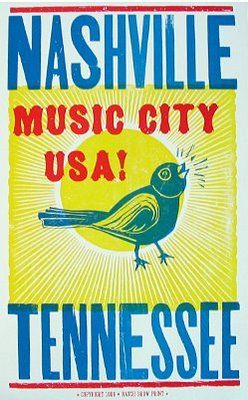
We drove into Nashville, then and now called Music City USA. Parked up and admired the State Capitol building, which was completed in 1859 and designed by William Strockland of Philadelphia. But there in the grounds was a monument, a homage to Andrew Jackson, infamous slave owner and then Tennessee’s favourite son and President from 1829 to 1837.
We walked into the city and found ourselves at the Country Music Hall of Fame, admission was then $1.50 and I saw fairly cheap displays with plastic models and quite poor drawings of Hank Williams, Roy Rogers, Hoyt Axton, Gene Autry and others. (Oh how things have changed in the interim.)
We bumped into an aspiring musician from Memphis called Smeed of whom we heard no more. Time to eat – we found a pizza place, but found it very thin and unfulfilling. We settled on an evening at the Bluegrass Inn with a jug of beer. There was some fine picking in the parlour that night. A 30 mile drive back to the Cedars of Lebanon with a Nashville Skyline in our rear mirror. For some reason I wrote down “Watch out for Jerry Jeff Walker” famous for writing Mr Bojangles. I’m not sure we saw him play but I must have picked up something about him. Next stop was Memphis over the horizon 200 miles away.
Part 7. To Memphis and beyond
Heading west towards Memphis and the mighty Mississippi we made a picnic stop at Natchez Trace State Park before going past Millington, a US Navy station on the way into Memphis. We stopped for the night at Meeman-Shelby Forest State Park. There we tuned into people playing bluegrass in the camp with the banjos and fiddles coming out to play, perfect music in absolutely the right setting for it. They were a group aptly called Countryside with four voices in harmony treating us to ‘Fox on the Run’ (originally by The Sweet) and ‘Down in the Blue Ridge Mountains’.
This was a damp night with continuous rain and thunder compounded by the deflating of the air mattress overnight. Rise to a hot shower and an oatmeal breakfast. (Who am I to disagree with my diary?)
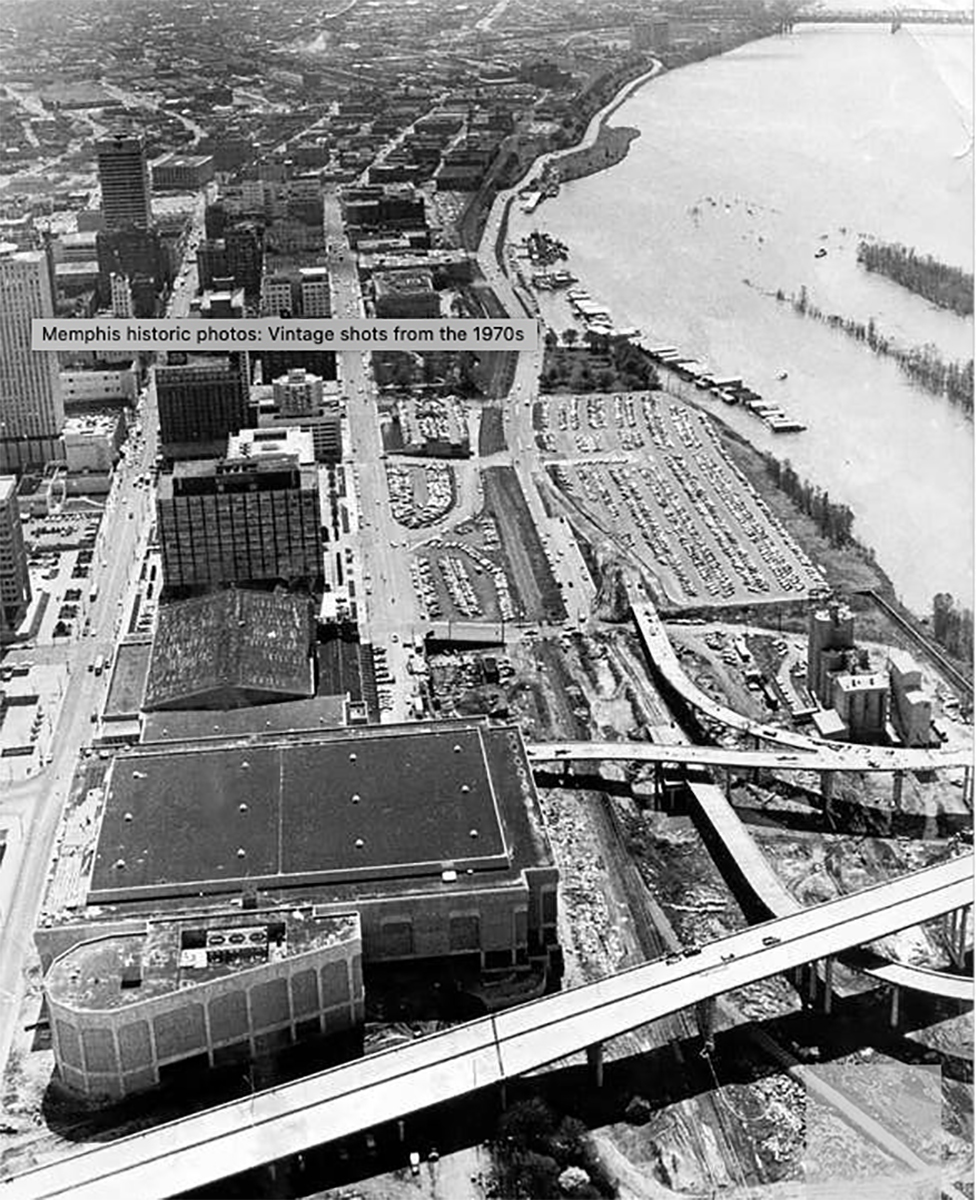
Take me to the river. Memphis on the Mississippi 1970s.
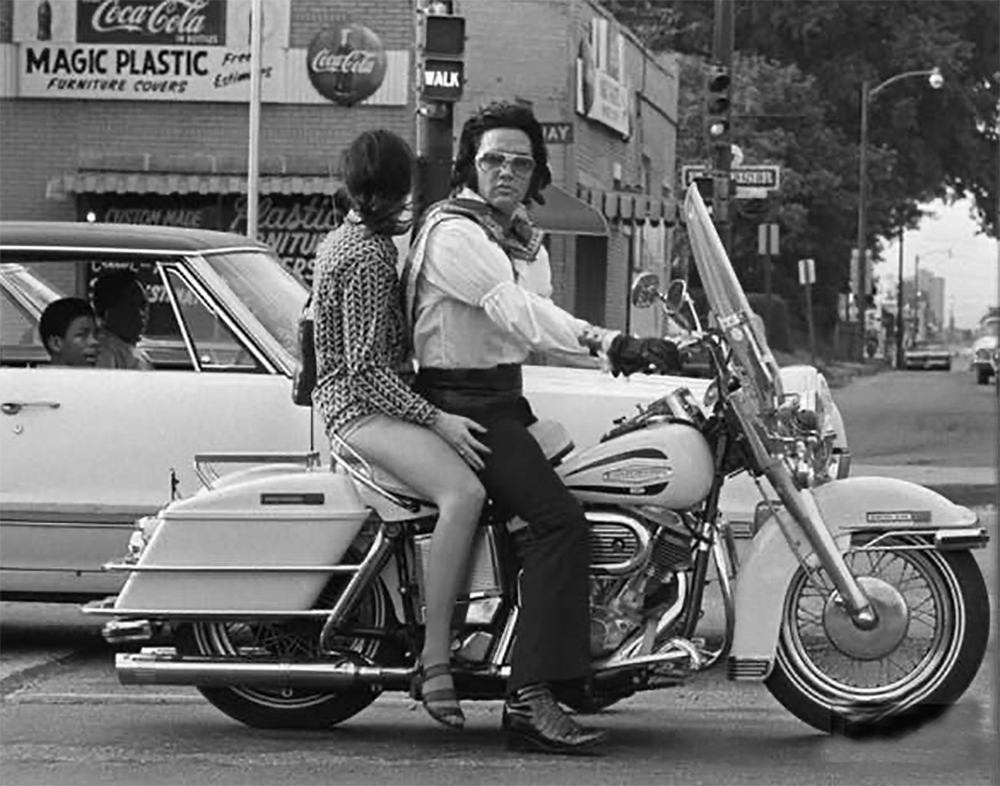
The Chevy found its way through downtown Memphis and we quite matter of factly passed the gates of Graceland, half expecting the man himself to come out and wave to us as we passed by, because Elvis was still very much alive then, this was just about a year before he passed, but all we saw were shuttered gates and drove on. Memphis, Tennessee by Chuck Berry came to mind.
If only….
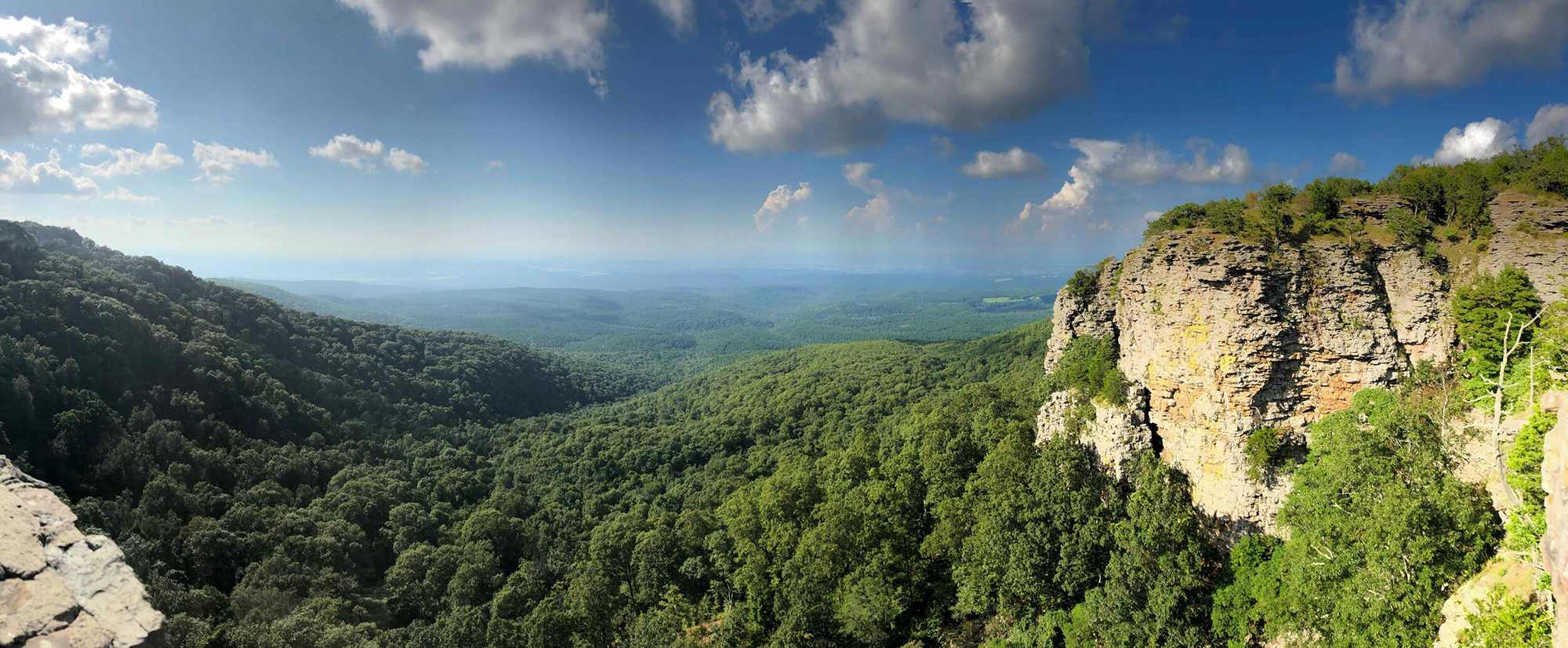
We crossed the famous ole Mississippi River and found ourselves in Arkansas. We must have seen all of five minutes of the mighty river, so quickly did we cross it, should have had more respect. The five of us, for now I’m counting the Chevy as a character in our journey, crossed great plains to Mount Nebo State Park, where we spent two nights for $2.50 a night. The elevation was 1800 feet and we had a breathtaking view of the Arkansas River Valley, but this was a very windy spot. More rain at night. I was reading Sinclair Lewis’s novel Main Street at this time.
I can’t recall a lot about Arkansas, my recall of its recent history recalls violence at Little Rock and the then Governor seeking to impede desegregation of the schools there causing Eisenhower to send in federal troops in the late 50s. We camped also at Lake Dardanelle, another pretty spot to spend a night.
The diary records that our tents were buffeted by fierce winds causing us to get up and get going just after sunrise and into the Chevy heading for Fort Smith, which was a long slightly bewildering drive punctuated by enormous roadside signs for fast foods. I noted the first appearance of ‘The Taco’ in the restaurants. Shopping in Safeway and then crossing the state line into Oklahoma and pitching up at Fountainhead State Park. (Nothing to do with Ayn Rand).
Mount Nebo view over Arkansas, found image.
Part 8 Oklahoma and Texas (hardly a musical)
We entered the Sooner State on Wednesday 4 August, almost two weeks into our haphazard journey with Merle Haggard’s “Okie from Muscogee’ ringing in our ears. There was an oil derrick on the lawns of the impressive State Capitol in Oklahoma City, which told me that oil was struck here in 1928. We paid a visit to the nearby Oklahoma Historical Association to discover that the state was founded in 1907 and that it was the 46th state. It was here that I read up about Will Rogers, wit, columnist, actor and Oklahoma’s favourite son, who was a member of the Cherokee Nation.
Will Rogers 1879 – 1935
I bought myself a black felt hat for $8 at a Cherokee Trading Post, sadly no pictures exist, and I can’t remember it, but this could have been the start of my subsequent life long interest in hat buying and wearing. A song that got loads of radio play at this time was ‘Take the money and run’ by The Steve Miller Band.
Oklahoma City was also the place where we connected with Route 66, then still visible in parts but much diminished and mostly superseded by I-40, but still resonating strongly in folklore. We hit sections of the famous old road where possible – that ran from Chicago to LA, with its own folklore and theme song – from Nat King Cole to Chuck Berry to The Stones and the rest.
We rolled into Red Canyon State Park off Route 40 at a place called Hinton, close by the Canadian River and felt we were getting close to the centre of this bicentennial nation.
Red earth was all around us and millions of ants were on the ground too. The next day we did a pit stop at Weatherford, OK to visit a launderette and Kris decided to pay a visit to the Southwestern Oklahoma State University, was she looking for a job here or to enrol as a student I can’t remember? But nothing materialised from it. Pineapple malts were then consumed. Why? It was Oklahoma after all. The heat was rising and the land was flat and there was not a tree in sight.
We were travelling in a straight line due west through the northern tip of the vast state of Texas. We didn’t meet many big hatted Texans, saw a few but little interaction apart from gas stations and wayside eateries. We were heading straight across the Texas Panhandle for Amarillo and of course the Tony Christie song was in our heads for hours. Palo Duro Canyon State Park was our next destination, this was our first stay in a canyon and it was a huge one, it felt like it belonged in a Western and we were in the desert at night for the first time. It was south east of Amarillo and due north of Buddy Holly’s hometown of Lubbock.
Palo Duro Canyon. Credit to Andy Rhodes
The evening meal for us that night was a typical Western kidney beans and rice. Back in Middletown, New York I had been involved with a college theatre troupe and the play I worked on, with sound effects etc was The Holy Ghostly, an early play by the prolific playwright, screenwriter and actor Sam Shepard, that reminded me of this Texas canyon. It was set in the lonely American desert badlands, home to witches garbed in coyote skins and demons. (Shepard came into play later on in San Francisco.)
A minor whirlwind whips through the tent at 2 AM, waking everyone up. In the morning there are many Texas doodlebugs about (large wood lice) and the sight of cacti was becoming more and more common in these desert conditions of over 90 degrees of dry heat.
Part 9 New Mexico at last and up into the Rockies.
After our brief journey across the Texas Panhandle it was New Mexico next, our 12th state and our first one in Mountain time. Our first stop inside the state was a place called Logan and then onto Ute Lake State Park, where swimming was essential to cool off. This was north of I-40 and the by now fairly discreet Route 66.
I wrote at the time “Plunge into a cool reservoir with a sharp sun and a liberating breeze. Disney skies while the bright moon rises. Take your seats for the sunset please.” But where was the photograph I never took?
The next morning our now so dependable Chevy steered us further west towards Santa Fe. Now this was a place we were all taken with, with its Pueblo style adobe houses and much Spanish influence, it was like entering a different world from the mid USA world we had driven through. It was the kind of place that you instantly think, yes I could live here. Kris and I bought a triptych of Sante Fe images for some future residence, but I can’t recall it now but it must have been compelling enough to purchase at the time. From Santa Fe we climbed into the surrounding mountains looking for a campsite and ran into an intense hail storm, which was so severe that we thought it would break our car’s windows. We camped at a place called Hyde Park and ate chilli and rice. After a wet, cold night the next morning brought a chill in the air and a breakfast of oatcakes. We filled up in Santa Fe with gas, oil and onions?
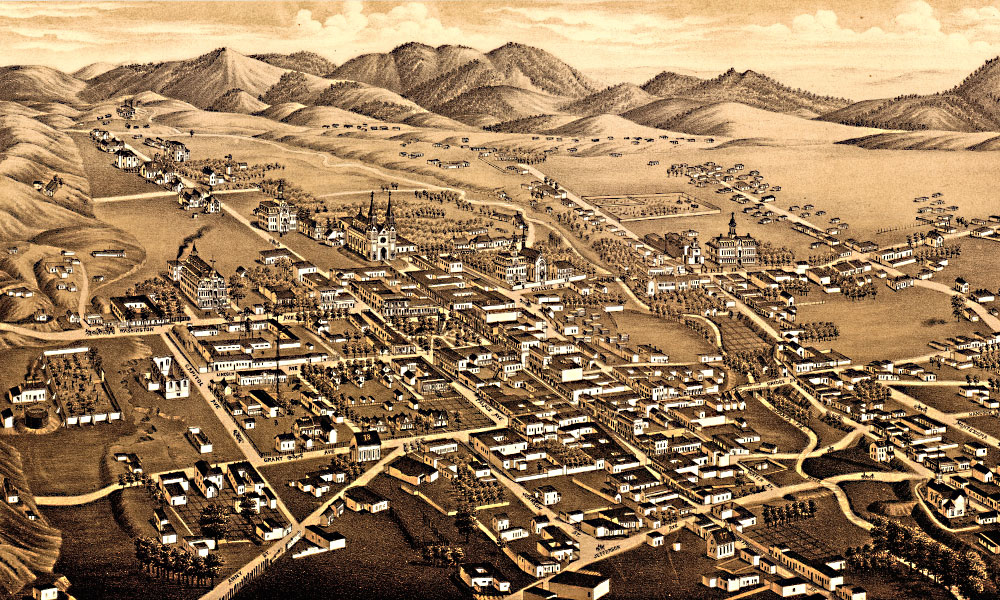
Santa Fe as it might have looked in the 1880s
The road north led towards the the state of Colorado and the Rockies, impressive and massive in front of us. Snow capped peaks immediately came into view, we camped beside a fishing lake with a present wind blowing into our shelter.
By the next afternoon we were in Denver Colorado. Kris briefly considered looking at the University of Denver as a potential place to work, she had a teaching degree in theatre studies, but it was not be be, we all had more travelling inside us. We camped that night at Cherry Creek, one of our more urban campsites on this road trip.
Boulder was our next stop via the Denver-Boulder Expressway, we went through Boulder into the foothills of the Rockies and looked for a campsite called Saw Mill, which we never found so instead plumped for Kelly Dahl Campsite in Blackhawk, three miles south of a place called Nederland. Next morning we took the twisted road down to Boulder, an alternative bohemian enclave at this time and the sprawling and vast campus of the University of Colorado. Kris was again looking at staying here. I didn’t want to, neither did Jane or Chris, but fortunately it didn’t happen.
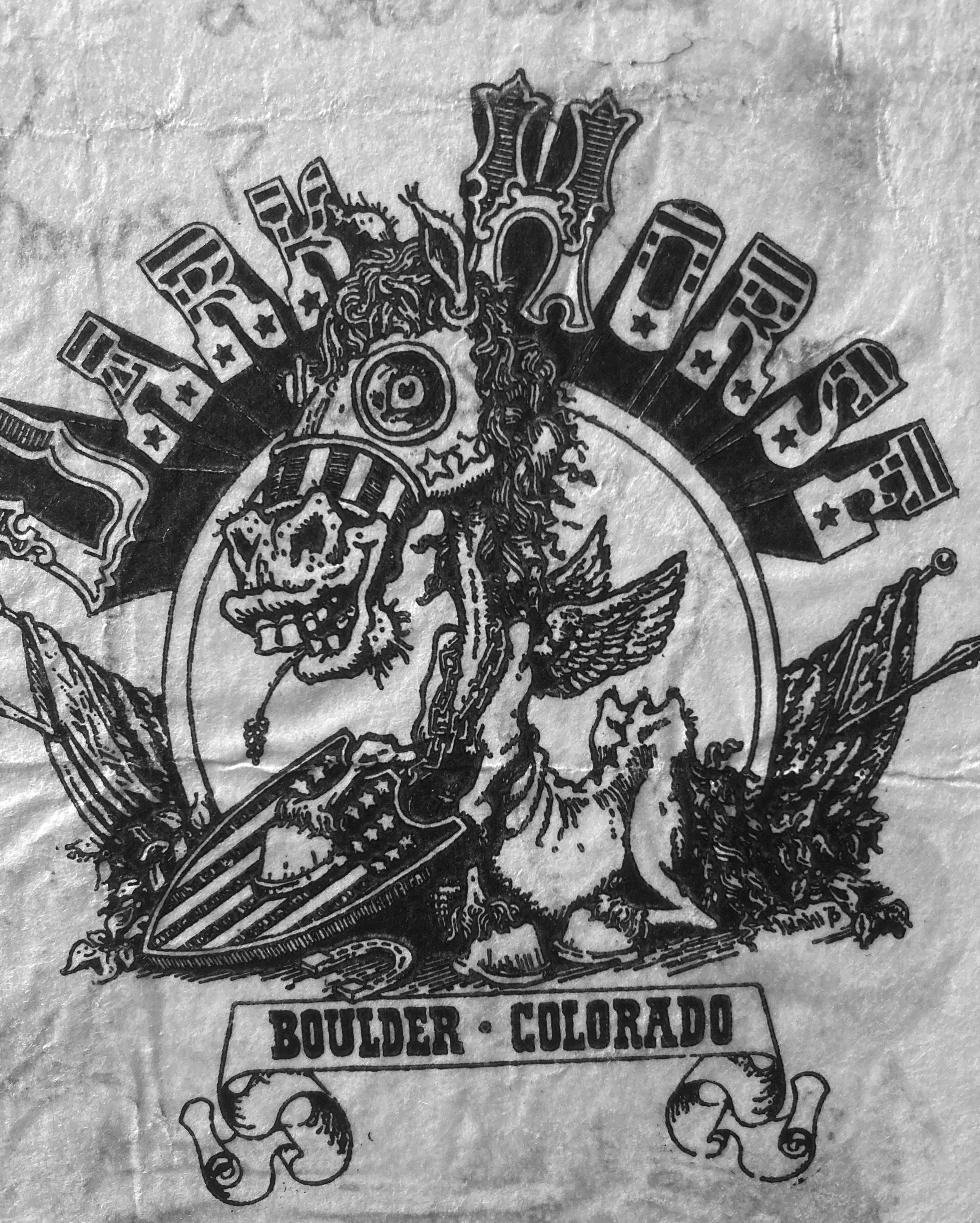
In Boulder we came across the Green Mountain Natural Food Store where we bought bulgur wheat, oats, soy beans, honey, tamari sauce and granola. After shopping we alighted on the Dark Horse, a restaurant and bar and venue full of memorabilia and oblique messages. A pitcher of beer was $1.25, we had three of them. After a huge harmless salad, comprising of mostly cheese and lettuce we heard the sounds of men cheering over in the corner. It was one of those wet T shirt competitions, (this was the mid 1970s) but we decided against joining the leering, peering men lined up whistling and cheering what they saw and left the establishment soon after and stumbled back to the campsite. Can’t remember who was driving that night.
This was glued onto a page in my diary.
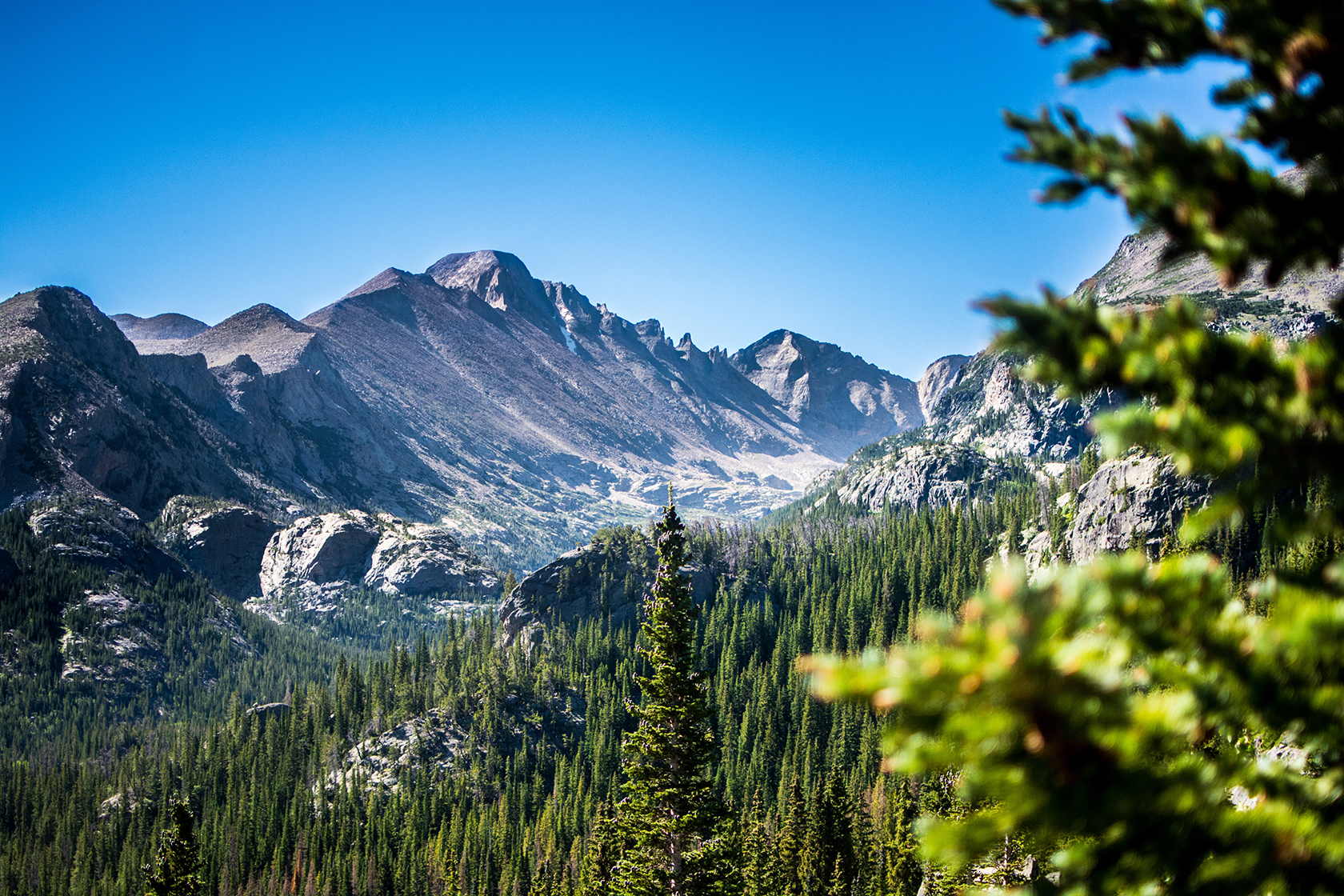
The next day, a Wednesday, we sped away towards the Rocky Mountains proper through Estes Park and near to Longs Peak on our way into the Rocky Mountain National Park, just $2 to drive through at the time. Where’s John Denver when you need him? We were driving through a broken landscape where frost had shattered the rocks, evidence of glaciers and almost an Alpine tundra feel, it felt like a very fragile world. The highest point we reached on that day was 12,183 feet above sea level and the weather was a mixture of snow flurries,bitter cold temperatures and some sunshine. We ran out of superlatives and just wondered at this extraordinary landscape in silence. We had crossed the Continental Divide into the Western side of the continent at Milner Pass. The rivers were now flowing towards the Pacific. The Chevy had passed the mountain test.
Rocky Mountains National Park
Part 10. Latter days in Utah and the Arches
We drove through the fragile world at the top of the Rockies, which felt crossing the top of the world, and eventually began to descend on the western side. Just past Shadow Mountain Lake we located Willow Creek where there was a peaceful lake at the campsite. The weather was cold and it rained at night. The next morning the sun was shining and we headed off west towards the state of Utah. 242 miles were covered that day going through the Green Mountain area and passing by the Blue, Eagle and Colorado rivers. We went through Vail Pass and 18 miles of major road repairs which caused some delay, but we didn’t care, time wasn’t really a limit. Through Rifle and Hot Sulphur Springs to Island Acres on the banks of the fast flowing Colorado River. It felt like we were in a Western movie and expected scouts to be picking us out from the top of the high cliffs that surrounded us.
The topic of money raised its ugly head and as were were pooling our expenses we determined to spend a whole ten dollars a day on running costs and fuel. None of us knew where we would end up. We drove to Grand Junction where we ‘robbed’ a bank for our cash and bought bread, ice and gas in that order. Some delays were experienced getting out of town on West 70.
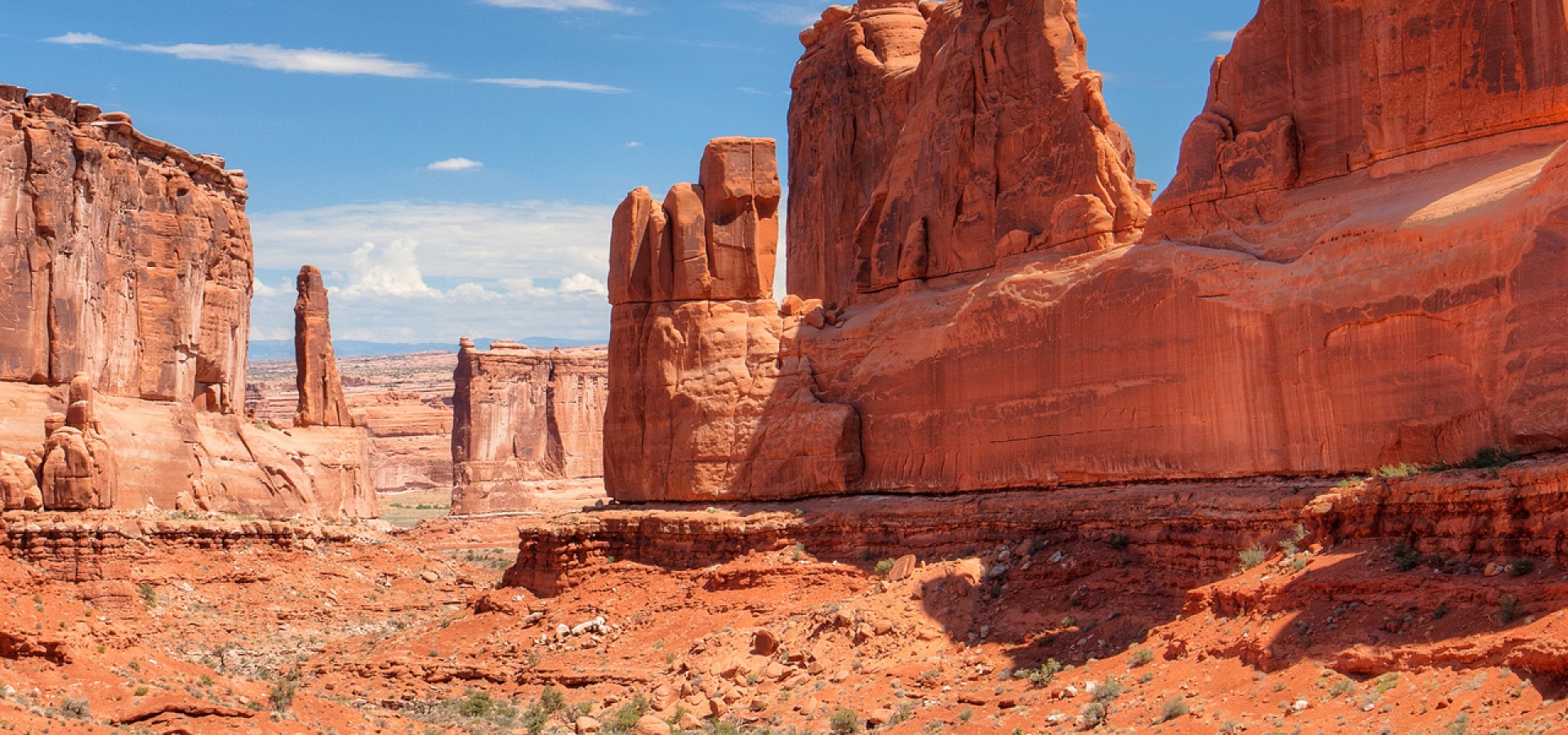
Utah was in front of us, all deserted and dry, in more ways than one. All I knew of the state was that this was the Church of Latter Day Saints ‘Mormon’ state and that it was dry of alcohol. The only signs of life as the highway stretched out in front of us were the telephone wires and the very occasional vehicle passing in the other direction. We pitched up in the biblical sounding town of Moab, which was an early Mormon town and in the centre of Red Rock Canyon country, we had decided to head for the nearby world renowned Arches National Park just a few miles north.
Like a Western landscape – The Arches.
The sandstone features of totally stunning and at times eerie towers, arches and balanced rocks had been carved out by wind, water, frost and sun over millennia. I wrote down at the time that over 150 million years there had been a deposit of 300 foot layer of the red silty Entrada Sandstone. We saw the graceful arches, the courthouse towers, the Tower of Babel, The Organ, The Window and The Three Gossips here. If the terrain looked a bit familiar it is because this area has been used as a location in many Western movies, beginning with John Ford in the 1950s.
Our touring Chevy stopped at Panorama Point, where we had a snack, but we missed out on Delicate Arch as we felt it too far to walk in the 100 degree heat. The majestic shapes hewn in the rock included the Fiery Furnace and the Devil’s Playground. We drove back down through Moab and onto Monticello, heading for Arizona. That night’s camping was in Manti-La Sal National Forest, well it sounded cooler in the mountains at over 10,000 feet.
Part 11 Drop into the Grand Canyon and a visit to Zion
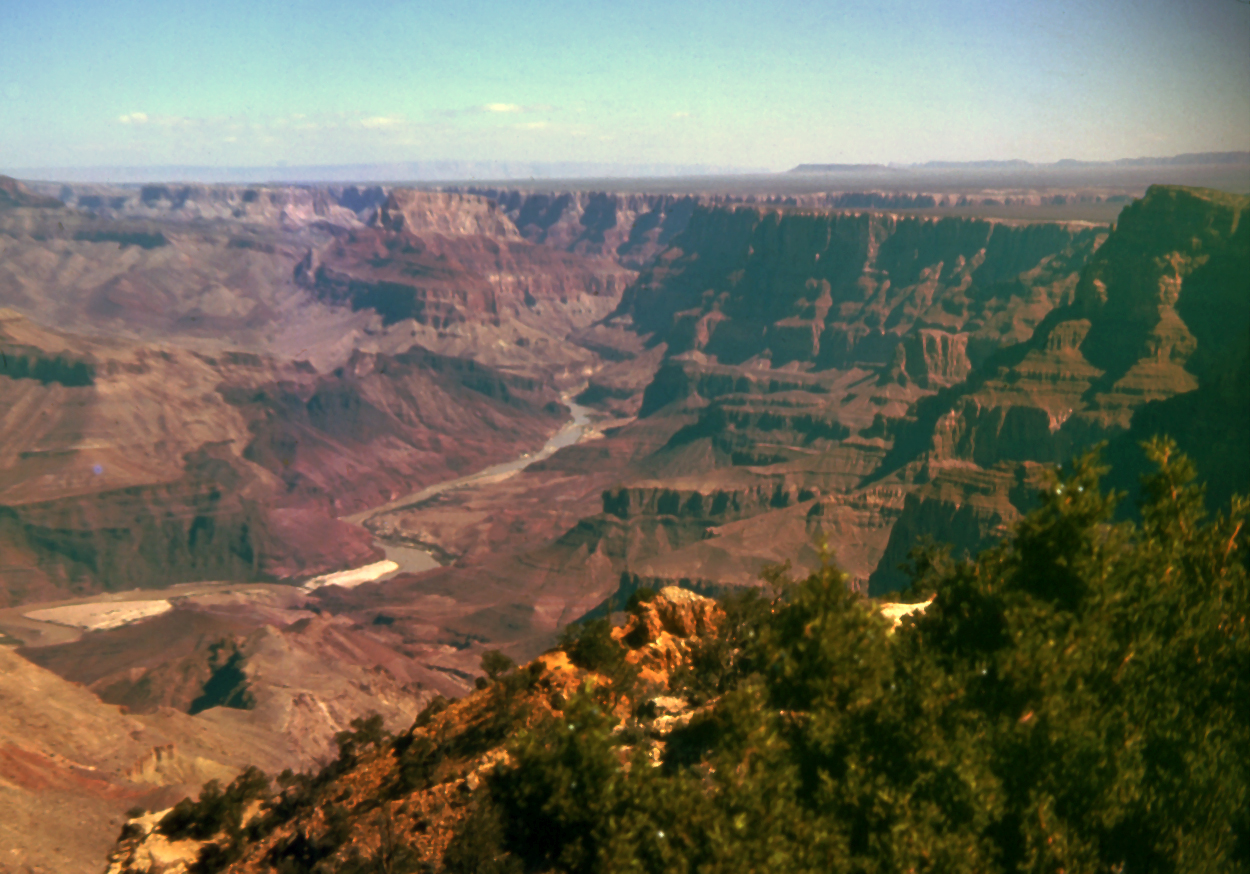
The next diary entry is from the Southern Rim of the Grand Canyon in Arizona. A giant yawning layered chasm stretching out for miles below and beyond us. The Colorado River that caused all this looks like a silver stream at the bottom of the canyon. We gingerly followed the Southern Rim trail, hoping not to fall in when a spectacular carved amphitheatre came into view. It was so, so dry and hot there in August, with just a few green spots of vegetation visible. A sightseeing plane flew over for a better view. Signs of earlier rock falls and a few birds who let us know they are there.
It’s Saturday night and party time at the Canyon campsite “with a Hopi Wind blowing down my spine.” Fellow travellers from Long Island share some ‘Hoboken Red’ with us and I walk over to the rim and gaze into the abyss. The next day there’s time for more canyon gazing and looking at the ruins of primitive houses nearby.
Taken from the Southern Rim, Grand Canyon
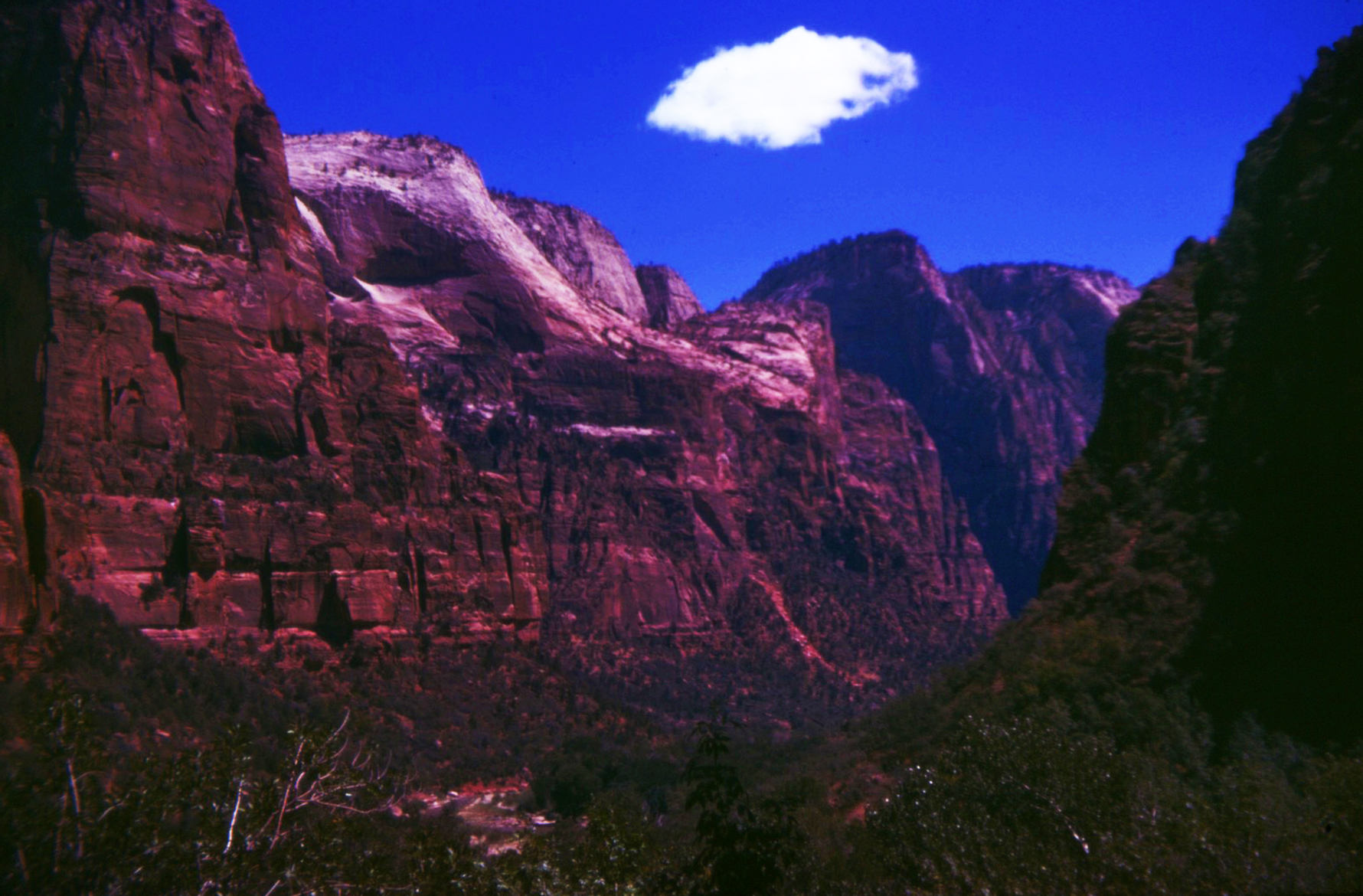
We drive back into Utah, it’s not that far and head for Zion National Park. Here there are towering red cliffs on three sides under a starry night with hardly any light pollution above. Shooting stars overhead explode across the sky for a moment, creating an exciting show in the heavens. Someone plays the flute in the distance across the campsite, it is a strangely eerie place.
Taken deep inside Zion National Park
We have now travelled almost 5000 miles on our journey and are about a week away from the end point of this journey. To be frank it will be good to have a break from this almost daily 200 mile journey. The goal for Kris and I is San Francisco where we hope to live, work and play, meanwhile Jane and Chris will depart back to the East Coast and catch a flight back to the UK.
Viva Las Vegas or bust?
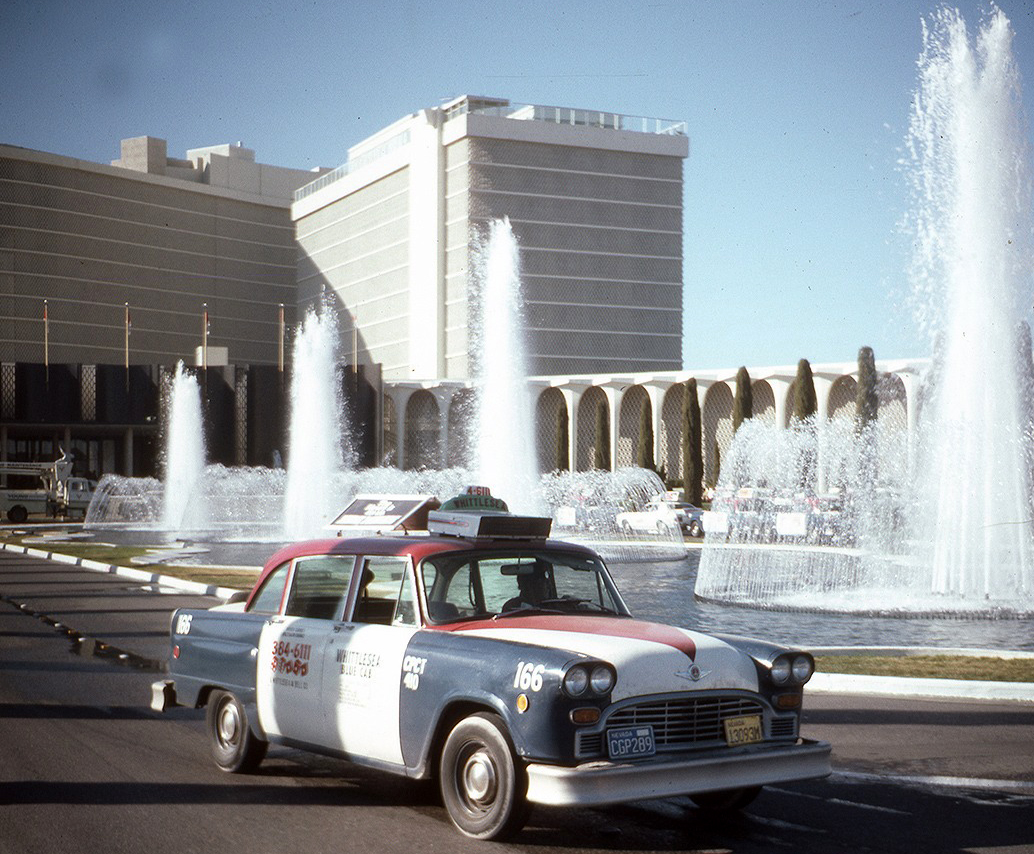
Like a shiny magnet in the desert the city and lights of Las Vegas pulled us in as we crossed from Utah into Nevada. I half expected to see Sinatra or one or other of the Rat Pack hanging out on The Strip but I was to be disappointed, but there were big signs advertising Tom Jones performing at Caesars Palace amongst a multitude of fountains. Why were we drawn to tacky Las Vegas, as none of us were gamblers? We were just curious to check out this city in the desert that never sleeps. We happened to meet a friendly off duty soldier, whose name I never noted down, who invited us to his apartment for a drink and a chat and he explained his view of Vegas, and gave us some tips. He was stationed at a base nearby.
70s Las Vegas
A few names of the establishments that I noted down at the time were Silver City Casino, Showboat, Lucky Lady and Mr Sy’s as well as the aforementioned Caesars Palace. They were all designed to pull you in to gamble with offers of all you can eat breakfasts for 49 cents as long as you play the slots or something else. Drinks brought to you while you play the slots. There were no clocks on the walls either, designed to make you forget how long you had spent there.
The wheel spins, the chips are down, the house always wins in the end. At night this was Neon City USA, creating the illusion of excitement and glamour. A motel advertises “a refrigerated pool and peace.” We didn’t summon up the courage to go for the tables, with our diminished financial reserves this seemed foolish, but we drank in and observed the behaviour of people addicted to the slots and the tables.
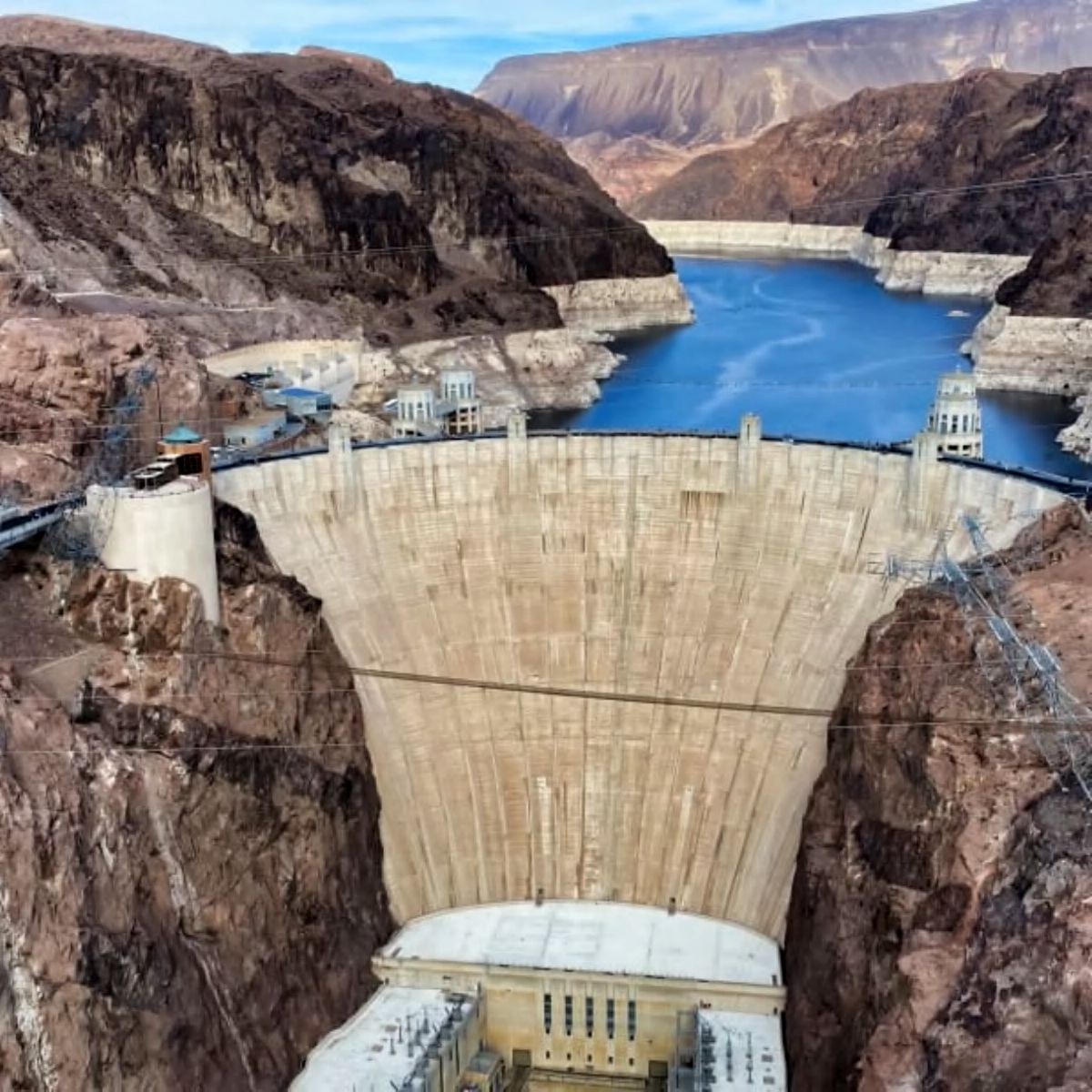
The next day was a recovery day away from the bright lights we travelled several miles east out of Babylon to Boulder Beach on Lake Mead. Pebbles, hot sun, a zephyr of a breeze and warm water to swim in. We moved on to have a look at the famous Hoover Dam where it tamed the Colorado River, an impressive sight, built in the 1930s under FDR’s economic recovery works to provide hydroelectric power and irrigation water to agriculture in the states of California, Arizona and Nevada. Thousands of construction workers helped to build it and over 100 died on site. We also drove on the road on top of the dam wall that day, this was Route 93.
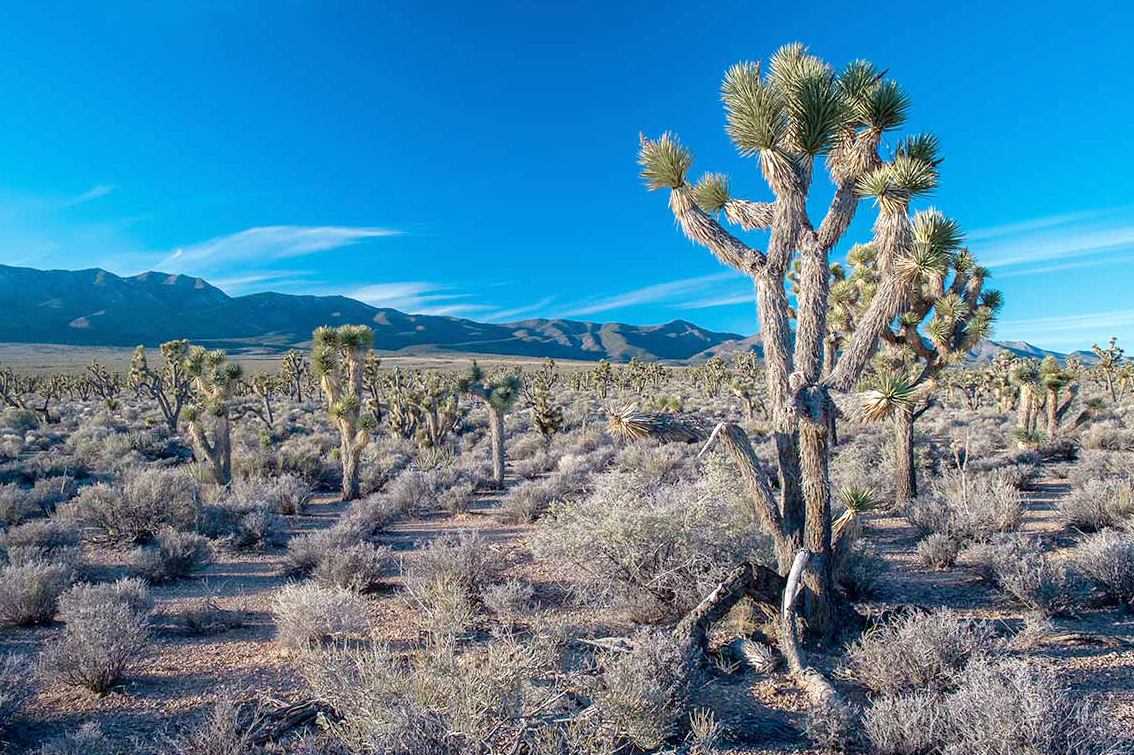
We were in a desert paradise and marvelled at the diverse vegetation of yucca, Joshua Trees (long before U2 named an album after them) and various cacti. We enjoyed Boulder City so much we returned the next day to stock up on gas, bread, taco shells and ice. Calm water and pebbles everywhere, a great place to unwind.
A brief return to Las Vegas to a place called Circus Circus (I wondered why) where there was a post office and Kris got news in a letter from her parents back in Goshen, New York. It all seemed so far away now, both literally and in the mind half a world away. We stopped at the Showboat Hotel and had an all you can eat lunch for $2.50 – various salads, garbanzos, red beans, sweet corn and iced tea. Stuff it all in while playing Keno. A meal of giant proportions far too big for my shrunken stomach and large eyes.
A little later we’re on our way out of Nevada and driving through the Mojave Desert we finally enter the Golden State of California.
Today was Friday 20th August 1976 and we had one week to go before we reached our final destination of San Francisco in the Golden State of California.
California Here We Come
One of our party, Kris, decides to push more coins into the waiting arms of a slot machine near Afton just inside the California state line, hoping that those melons, oranges and raspberries to line up. They don’t. Chris and Jane play Keno and win some, lose some. I watch and decide that gambling is not for me, while an ant bites my ankle and the sun slowly descends. We are still in the Mojave Desert and it is warm and arid and we are parched.
It is now Saturday 21st August and today we finally get much closer to the Pacific Ocean. We drive through San Bernardino and reach Featherly Park, Anaheim where we camp in the overflow campsite where for $3 a night we pitch our two tents. The next morning we drive on towards Newport Beach where the ocean is blue, calm and very salty tasting (unsurprisingly!) and then onto Long Beach where the seagulls gather overhead and we pitch the tent in a ditch for some unknown reason. There’s a surreal party atmosphere on the beach with mostly tanned and toned Californians showing off.
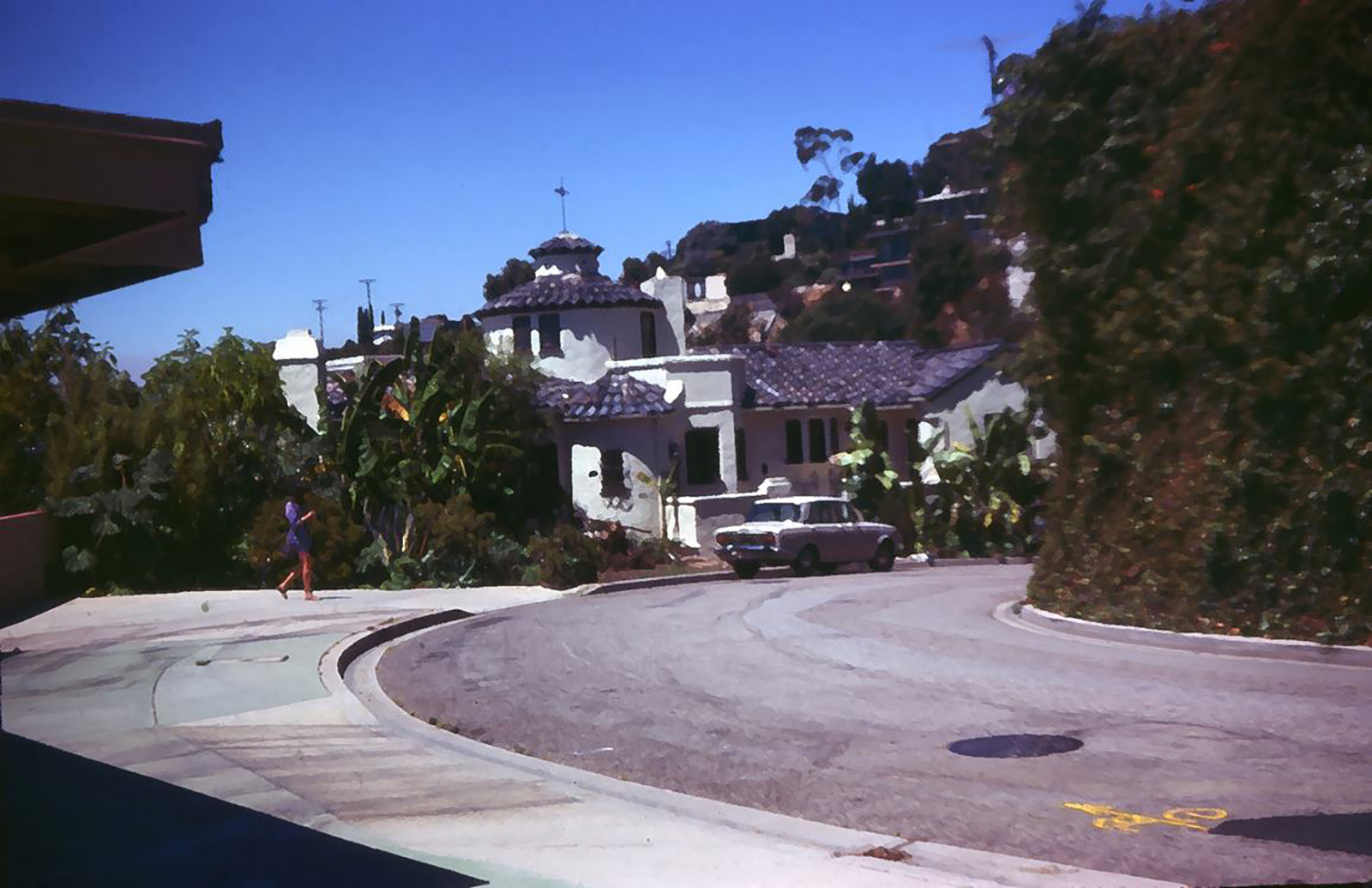
Sunday 22nd and the mood in our camp isn’t so good, there is tension and bad vibes about, could the reason be that we are nearing the end of our journey? We drive into Los Angeles in the old Chevy without any fanfare – a huge, sprawling metropolis, parts of it looking strangely familiar from films and TV. We have no idea where to go so we head for a name and place we recognize – the sign on the Hollywood Hills. We drive up into and around Laurel Canyon, possibly looking for either Joni Mitchell, who lived there at the time, or John Mayall whose album ‘Blues from Laurel Canyon’ came out in 1968. Not a film or music star in sight.
Laurel Canyon – Hollywood, Hollyweird
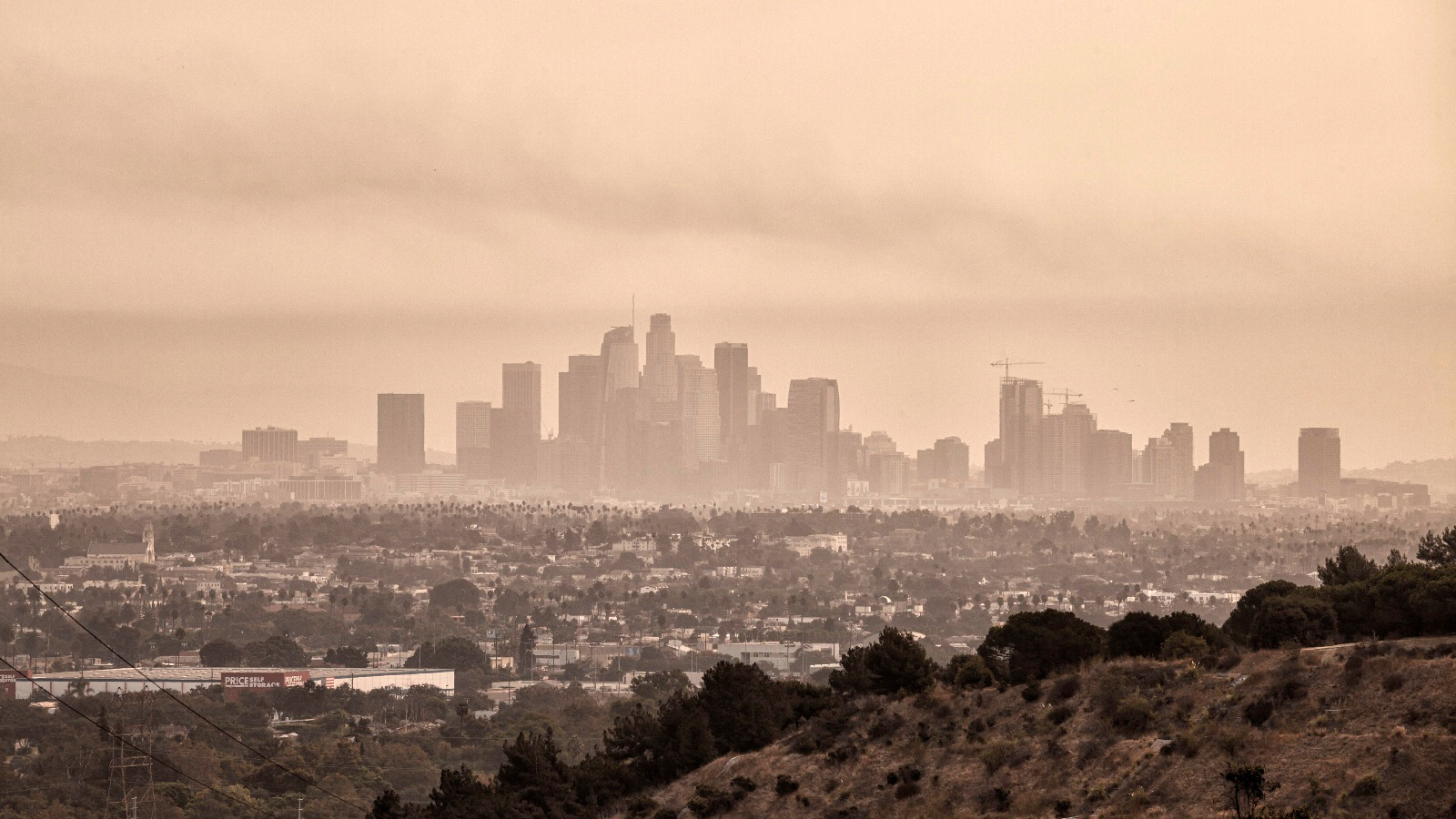
There’s a fine view of the LA smog line from above and there’s Beverley Hills and Bel Air over there. The signs point to Sunset Boulevard, Burbank and Santa Monica way over there. It’s only a day spent here, not enough time to take much in. None of us feel that we want to stay here for long – Los Angeles feels too big, too many people and not relaxed. We come out the other side and camp north of the city near Oxnard and later dive into the safe ocean.
Smoggy skyline
On the next day we reach Point Mugu State Park about 30 miles north with its Mediterranean climate with masses of palm trees and yuccas. It feels like a sub tropical paradise, no wonder people are drawn to the West Coast like a magnet. The night before we visit a bar to play some pool and drink beer.
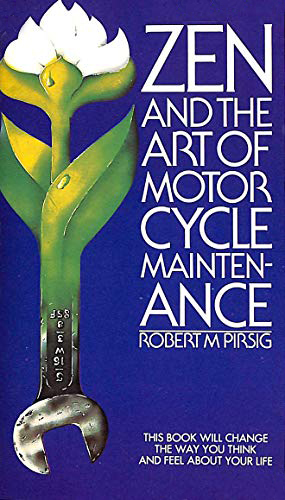
In the morning I spent some time continuing to read the then enormously successful philosophical ‘Zen and the Art of Motorcycle Maintenance’ by Robert M. Pirsig, published two years previously and lent to me by Chris. It is a fictionalized autobiography of a long journey that Pirsig made on his Honda CB77 motorcycle from Minnesota to Northern California along with his son Chris in 1968.
While I read on the beach, the tide has almost come in, Kris wipes her glasses, Jane sits drawing at a table beyond and Chris is reading a free LA newspaper. It’s 11am and 70 degrees and a boat sits out at anchor swaying gently in the light breeze.
Highway 101 runs behind us. Trucks, cars and bikes roar along the ocean front. Paul Simon’s song ‘50 ways to leave your lover’ is playing gently on the radio nearby. Kris tries to distract me while I’m writing this page and enjoying the peace, feeling quite relaxed with the sun, the sand, the ocean and music in the air.
The next day we hit Santa Barbara a little further north up the Pacific coast. The town had a genteel Spanish feel, a place where I think I could possibly live. Some grocery shopping and then trouble finding a campsite that had room for us, we finally land upon Oceano Memorial Park, just north of Santa Monica where the showers cost a quarter and we are squashed into a small patch for the night. We are now officially locked onto Highway 1 which clings to the ocean and will take us north to San Francisco in a few days.
Heading north up the Pacific Coast
San Luis Obispo*, a little further up the coast on Highway 1 was our next port of call. The dense sea fog had lifted at about 9am and my diary tells me that we stopped for a breakfast of doughnuts (how things have changed?). We set off on Highway 1 towards Big Sur, a place we had all heard off, we passed the Hearst Castle at San Simeon, where tourists queue to gape. For my part I could only think of Orson Welles’ portrayal of Citizen Kane. The first campground we tried was full so we ventured onto a place called Fernwood where for $6 we had a pitch for the night.
The next morning as we drove over a bridge disaster struck and the muffler (exhaust pipe) snapped in two. Some hasty temporary roadside repairs allowed us to continue for the time being. The wild region called Big Sur called us and we spent a couple of days in the area, swimming in some wild seas, being buffered by high winds and enjoying the spectacular scenery. Kelp seaweed was lying about in abundance too. We enjoyed camping among the California redwoods not far from the coast, so much so that we booked in for another night there. There was a stream near the campsite we could dip into. I was enjoying reading a sci fi novel by Robert Heinleim at the time, was it ‘Stranger in a Strange Land’ I wonder? We made a meal that night of bulgur wheat and garbanzos washed down with a cheap Californian pink chablis – (gut-rot it says here). I watched happy people getting high on square dancing nearby but felt sick to my stomach from the lousy wine.
Thursday 26th August out last full day on the road before reaching our final destination. We drove to the town of Monterey with what was left of the muffler making noises it shouldn’t have. There was a Jimi Hendrix soundtrack playing in the car which seemed fitting at the time. Monterey appeared to be a small, neat town, somewhere that we could have settled in for a while, but no, we had to first find the Midas Muffler Shop where we had two pipes fitted and the box replaced for a princely $45. For the first time on this whole trip we visited a McDonalds for breakfast, as a vegetarian back then it wasn’t always easy to find things to eat in the world of fast foods. I didn’t visited another one for many, many years.
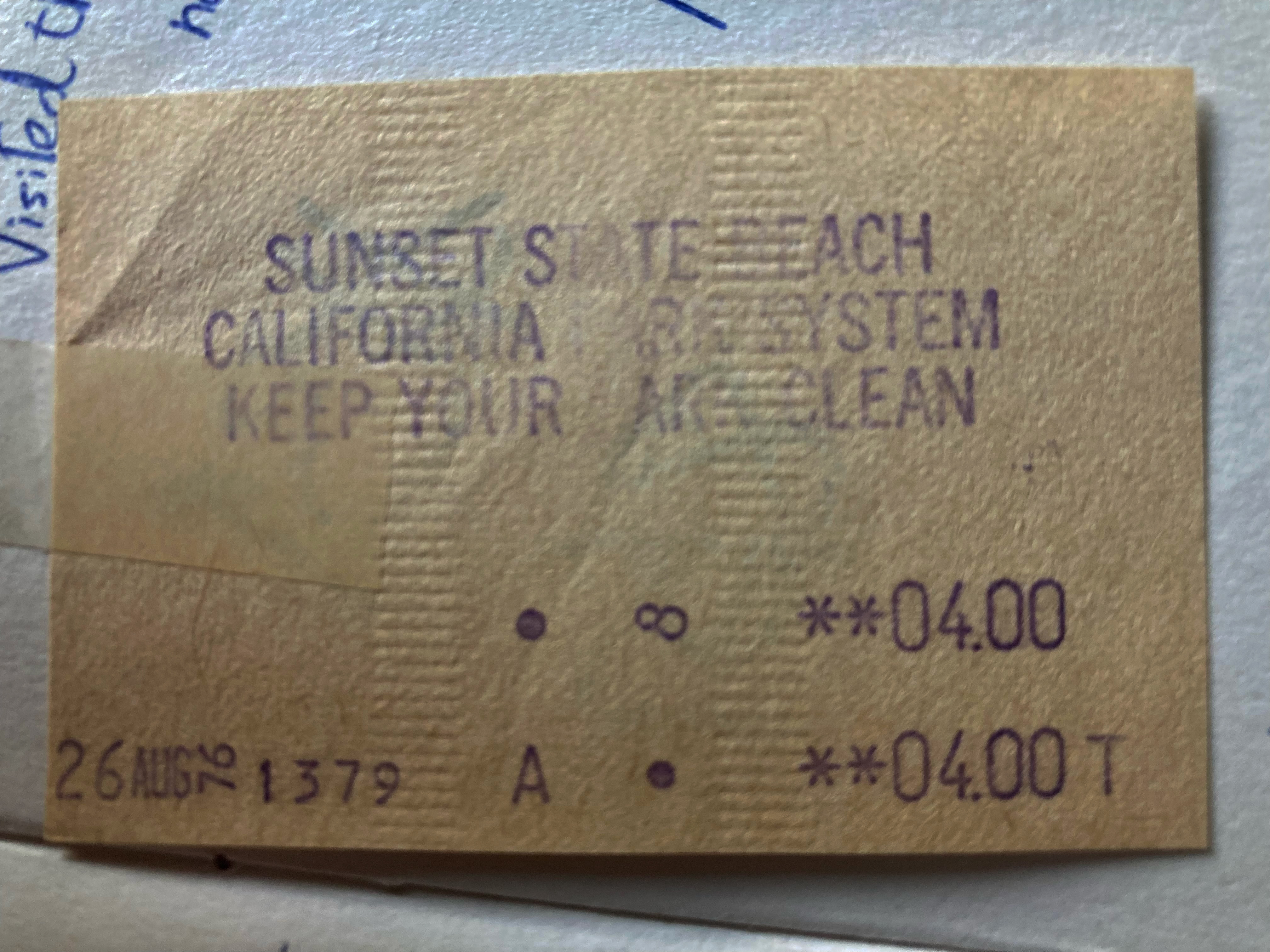
We picked up some shopping in the town and bought some groceries and then drove onto Castroville, which proudly proclaimed itself as “The Artichoke Capital of the World” where you could buy 50 small globe artichokes for just one dollar and cauliflowers at 9 cents each. We eventually reached Sunset State Beach, near Watsonville, for our last night of camping on this trip and let ourselves get washed by the gentle white waves and felt satisfied. We watched the sunset near to Santa Cruz with a pervasive end of the journey feeling about us.
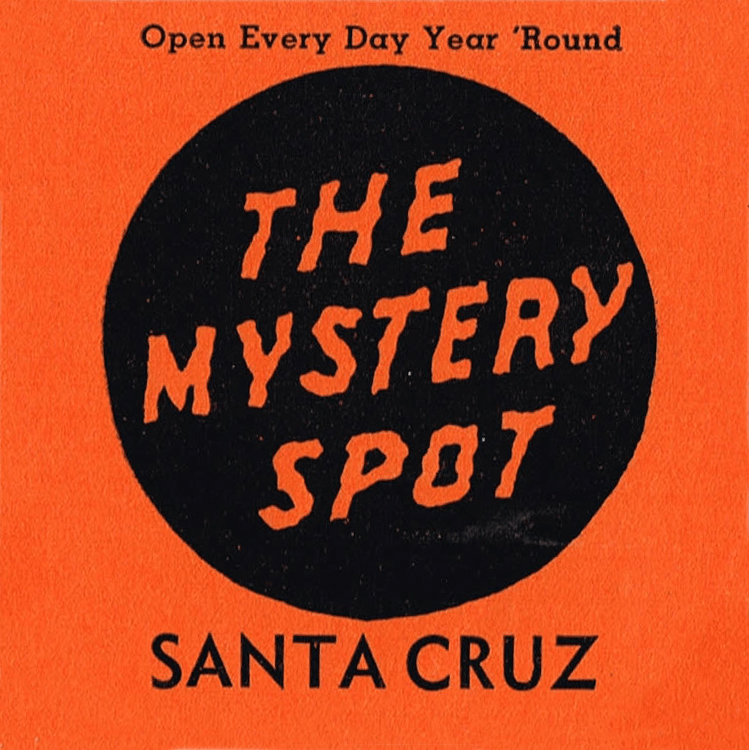
This was now Friday 27th August and we were just a mere 70 miles from the end of our journey. We took a punt and decided to visit the Mystery Spot, in amongst the redwoods near Santa Cruz, which proclaimed itself as a place where gravity holds no bounds. Was it a site of a meteorite landing way back, was it a vortex, a strange gravitational force field or possibly an elaborate hoax? We witnessed what appeared to be a golf ball rolling up a plank, trees growing in an anti clockwise direction and an area where there appeared to be a different gravitational pull. Things were definitely out of kilter here. For only $1.50 entrance even it was a hoax it wasn’t that hard to swallow and it was quite an entertaining visit. We left and headed for the city by the bay, reaching halfway to the stars…
* San Luis Obispo features again later in my story from 1978 when I was part of a campaign of activists from Northern California and elsewhere determined to stop the building of a nuclear power station at a place called Diablo Canyon, SLO being the nearest town. The objection was based on the fact that there is an earthquake fault line running right through Diablo Canyon, an off shoot of the San Andreas Fault. At this demo I was nearly arrested in a sit down protest and thereby narrowly avoided being deported as an alien. I remember Jackson Browne turning up and singing a few songs at the event too. The power station got built in the end despite a few delays, such was the lobbying power of Pacific, Gas and Electric.
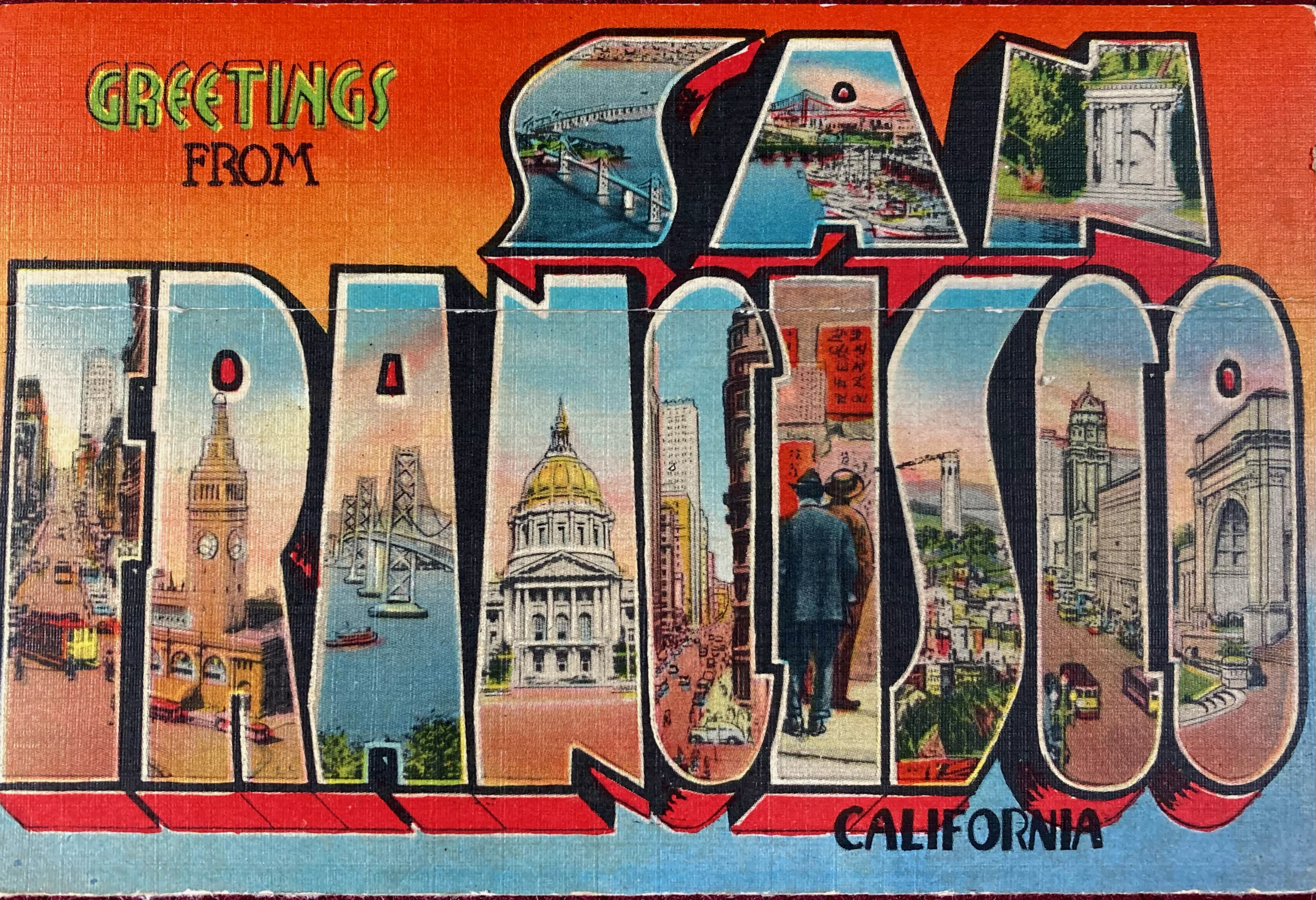
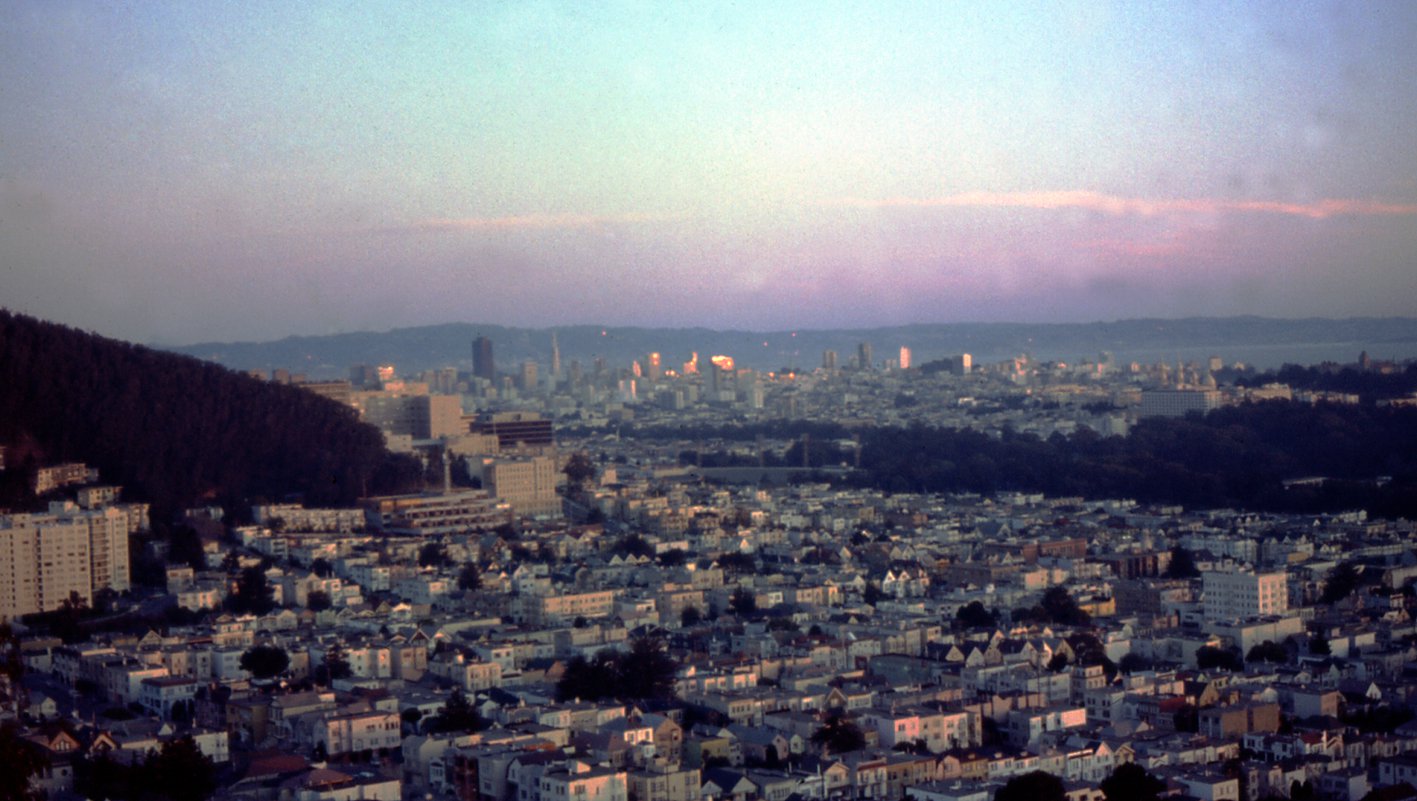
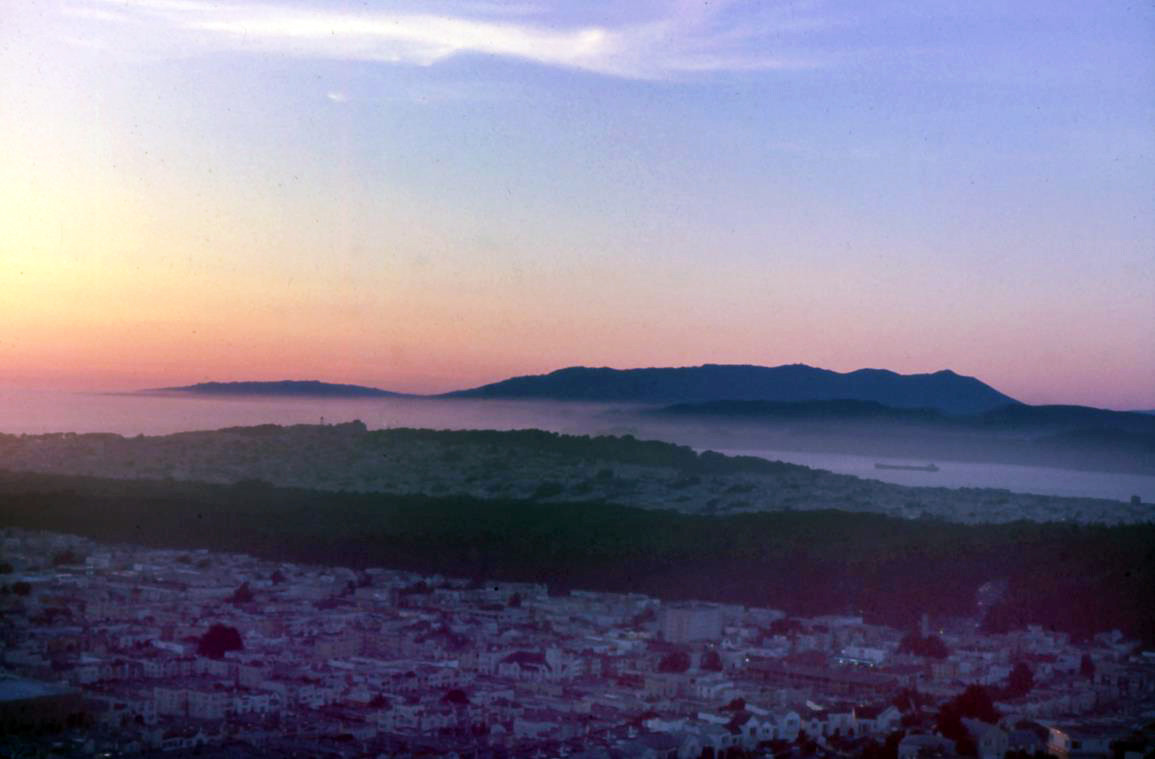
Welcome to the city!
Our silver Chevy rattled along Highway 1 past Half Moon Bay, Pacifica and we eventually entered the suburbs of Daly City and the southern approaches to the city. There was signs appearing for the 49 Mile Drive, I wondered at the time what it was. (I drove the whole route later). We excitedly drove right into the centre of downtown San Francisco and headed for the Main Post Office somewhere on or off Market Street, narrowly avoiding the suddenly confusing input of trams, cable cars and buses. We collected a few forwarded letters there from family in the UK. I learnt that my theatrical Uncle Alfred had died in Manchester sometime over the summer.
There was that famous San Francisco fog creeping over the hills from the Pacific too. We had a packed lunch of sandwiches and root beer in a parking lot, I don’t remember why, maybe it was to gather our thoughts. The first task was to seek out Enid, an old college friend of Kris’s from Brockport, NY. We found her eventually and spent an hour or two chatting. Enid was a bit pessimistic about the prospect of us finding jobs in the city, but did offer some friendly advice. Another acquaintance from Kris’s past, Carol Thompson, kindly offered to put the four of us up for a couple of nights, she lived in the Inner Mission district and was most hospitable.
Our first night we trekked over by bus to Chinatown to a cinema showing a double bill for a dollar, this fitted our budget. Can’t believe it now but we watched Spartacus and The Royal Hunt of the Sun that night. We walked over into North Beach, that haunt of beat poets afterwards for a bite to eat and a coffee and a quick look at Little Italy. I began to feel like I had arrived in a city that was like nowhere else in the USA. There was such a heady mix of people and cultures all in one place. We returned to Carol’s apartment and crashed.
The next day, Saturday, we were directed towards a performance of the famous San Francisco Mime Troupe in nearby Dolores Park. A famous agitprop political troupe, they had been around since the late 60s. This performance was about the US involvement in the Spanish American War over independence for Cuba in 1898 and featured Teddy Roosevelt and miners. A theatrical political history lesson.
On the Sunday we all went for a long drive in the Chevy around the area and drove over the Golden Gate Bridge for the first time with the seasonal fog rolling in and went into Sausalito in Marin County and ended up going through Richmond, Oakland and Berkeley, returning via the Bay Bridge. I remember being impressed by the natural beauty of the Bay Area. I was happy that we had decided to make a home there for the time being.
On the Monday we drove Jane and Chris to the other side of the Golden Gate Bridge and said goodbye to them as they started to hitchhike the long road back to New York and the UK, they took a more northern and direct route this time. They were successful, but I can’t remember how long it took them to do it.
At this point the road trip was essentially over, the four of us had spent an awfully long time, some six thousand miles over six weeks, squashed in together in our two door Chevy. Relations were a bit strained at times, harsh words were spoken from time to time, but I recall that we tried to get along. But I think all parties were happy to reach the end of the road and go our separate ways.
I saw my sister Jane and Chris again the next summer in the UK on a short summer visit. Jane had an art studio in Bristol and Chris was a mobile DJ, who later on became the continuity DJ on the main stage at Glastonbury – and still is! Kris and I lasted another two years before an acrimonious break up and after leaving the country she divorced me and we never met again.
One of the reasons I was drawn to this city was that several years before I heard and got into the song ‘San Franciscan Nights’ by Eric Burdon and the Animals. I later discovered that there was no such thing as a warm San Franciscan night. But I had joined the University of Life and this was the place to find myself. Little did I know that I would be there for nearly four years.
It was in that strange pocket of time between Christmas and New Year and the small market town, which felt like it should be located near the sea, but wasn’t anywhere near it, was having its annual slumber. The ancient Mummers play had been, told its story and was gone already and it was that time when strangers in the street for a day or two gave out an extra modicum of greetings as they passed each other, as the festive decorations began to lose their meaning.
In the early hours the late bar was about to close for the few remaining stragglers, who had stumbled upon it in search of more drink, uncaring what they had spent, as they were protected by an alcoholic bubble from thinking too deeply. The tall man with the nautical beard made his way unevenly up the street towards his home, dancing to his own internal rhythms. His key knew which way to go.
The town began to draw silent deep into the night, when the only sounds were the occasional noise of a few cars in the distance and the screech of neighbourhood cats crossing paths.
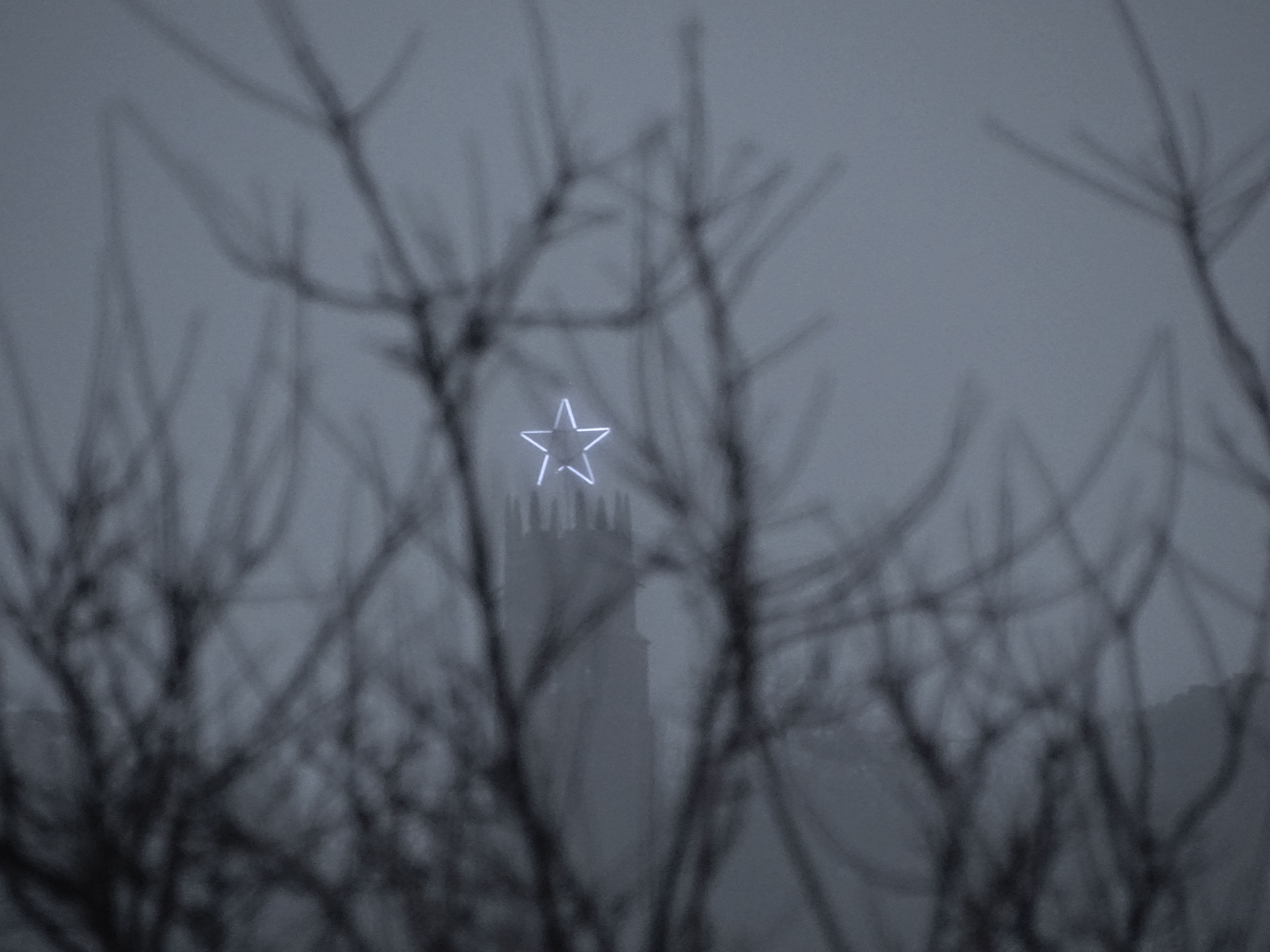
In the dull grey morning the white star shone brightly from the top of the tower overlooking the sleepy town, guiding the ghostly milk float on its fanciful journey. The commuters rose at this early hour and one by one got into their cars or jumped on the bus and took their chances heading out on the busy A road…
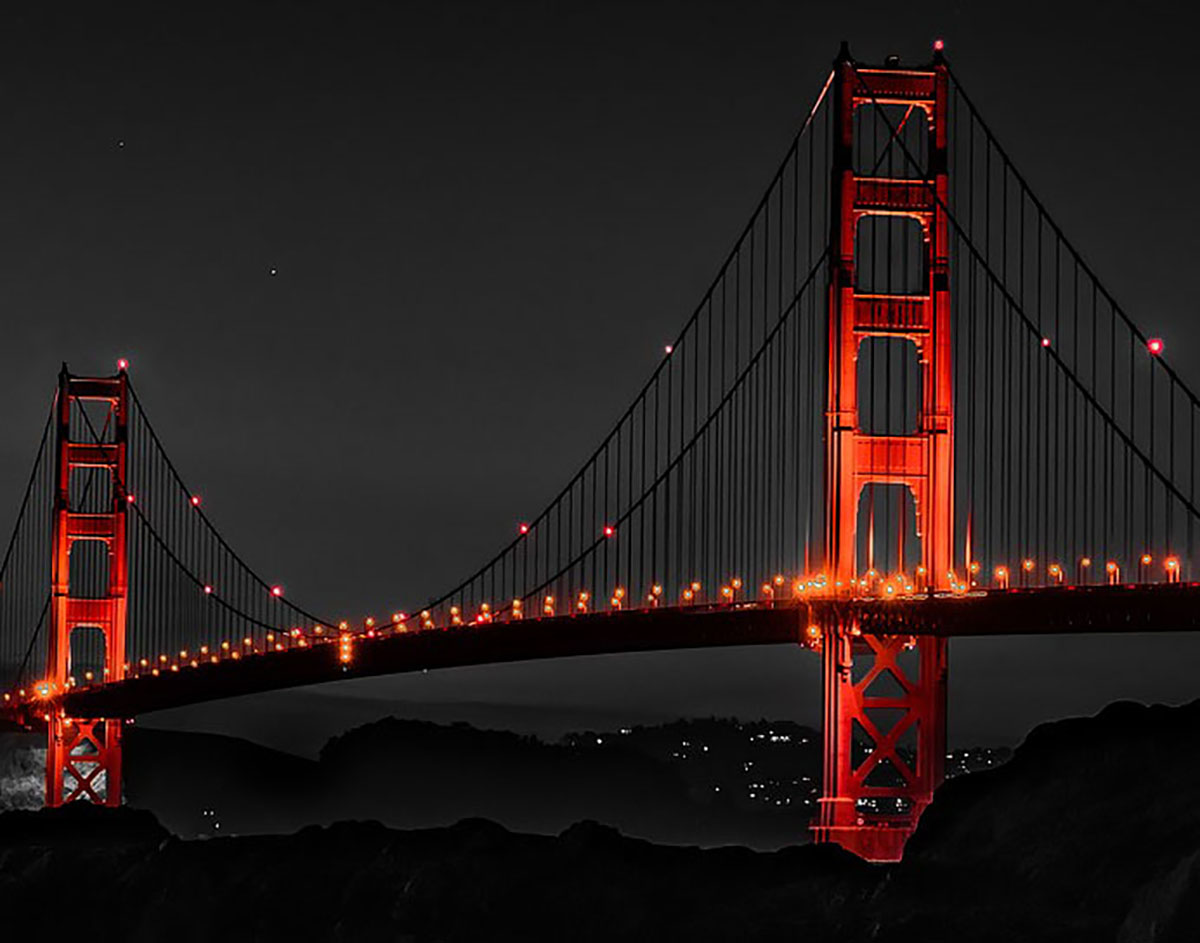
One of the few regular Suicide Club events was the annual Potluck Dinner on Golden Gate Bridge held at the end of February each year, which began in 1977. I signed up to go on the second one in 1978 and have a vague memory of making a tub of potato salad and packing it along with a grape drink (or was it wine?) in a back pack and heading off on the bus towards The Presidio. We disembarked and met up with the 40 or 50 people who’d also decided to join in for the dinner. It was just getting dark and the city lights were beginning to twinkle in the twilight as we walked onto the bridge on the pedestrian path, not too close to the traffic, there was a barrier between us. It was a warmish and windless evening. People carried fold up tables, chairs, table cloths, plates and cutlery and we assembled together at the appointed place on the wide pedestrian path close to under the first tower we came too.
About 20 minutes into the meal, a police car turned up and two cops got out and asked what we were doing. Someone replied that obviously we were having a meal on the bridge. The cops looked at each other, scratched their heads and said that we weren’t breaking any laws as long as we were not obstructing anyone. They got back in their cars and drove off. It was a wonderful setting for a candlelit dinner, if the food was a bit random. Maybe the wine did come out later and we all had a few. There were spectacular views of the San Francisco skyline as well as the lights of the towns on the Marin County side. Sadly no camera on this occasion, what was I thinking?
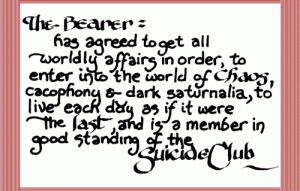
I landed in San Francisco in August 1976, with my then girlfriend Kris, at the end of a six week, 6000 mile road and camping trip in a beaten up silver blue mid 60s Chevy Nova. But that is another story, in this one I’m more interested in how I found myself in this city and immediately sensed that it was where I wanted to be – for now, and how I came to be involved in the Suicide Club over the next couple of years. The city was no longer the hippie enclave of years before, it was harder, and had more social issues, although strong remnants of that counter cultural time in the 60s still remained. I remember one long term resident called Kathy who said “Living in the city was good but once in a while you’re going to step in the dog shit.” She was in fact the first person I remember telling me about the existence of this shadowy group called The Suicide Club. My interest was piqued.
Kris and I first lived in the Haight Ashbury, renting an apartment from a slightly dodgy landlord called Carlos. I found work eventually as a walking courier, carrying plans in tubes from one high rise office to another in the downtown district and then moved into temp office work. Outside this time I began to cultivate and explore the social world around me. I walked a lot, exploring Golden Gate Park, the Mission and Castro districts, in fact all over the city.
Within a few months I had met some people in the Haight district who pointed me towards the Communiversity magazine. This was a free university, which offered classes in all kinds of esoteric subjects. It listed local and free classes in the neighbourhood. Several of these classes took place at The Circus of the Soul Bookshop run by a character called Gary Warne, who turned out to be one of the main instigators of the Suicide Club. So one thing led to another and I found myself in the spring of 1977 subscribing to the monthly Nooseletter, which listed all the events and activities that were on offer within the Suicide Club the following month. (The name was chosen deliberately to deter some people and invoke a sense of danger too.)
First there was a ‘so called’ initiation ceremony to induct newcomers to the club. It had no official membership or rules to speak of, except that on this night there were no drink or drugs involved. This event, which from memory occurred on the night of the Chinese New Year involved being blindfolded at the start and then having to follow and track down clues across the city, travelling by bus and on foot. From memory this ended up at the end of the evening in an elaborate gathering near The Palace of Fine Arts. It was entirely peaceful and enjoyable but with a surreal sense of humour surrounding the activity. I was in.
What follows are some of the activities I took part in. Sadly no photographs of mine exist.
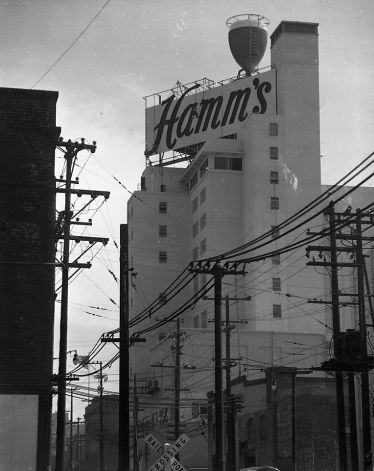
It was the summer of 1977. A night was chosen to get into and explore Hamm’s Brewery. This brewery was a local landmark, which had fairly recently closed down. It was on Bryant Street in San Francisco, a tall building with huge metal cylindrical vats. I was among a group of Suicide Club members who broke in and crawled all over, up and down and inside the metal vats. We made some strange sounds effects by banging things and using our voices. The brewery site was later famously squatted and became a centre for musicians in the punk music scene.
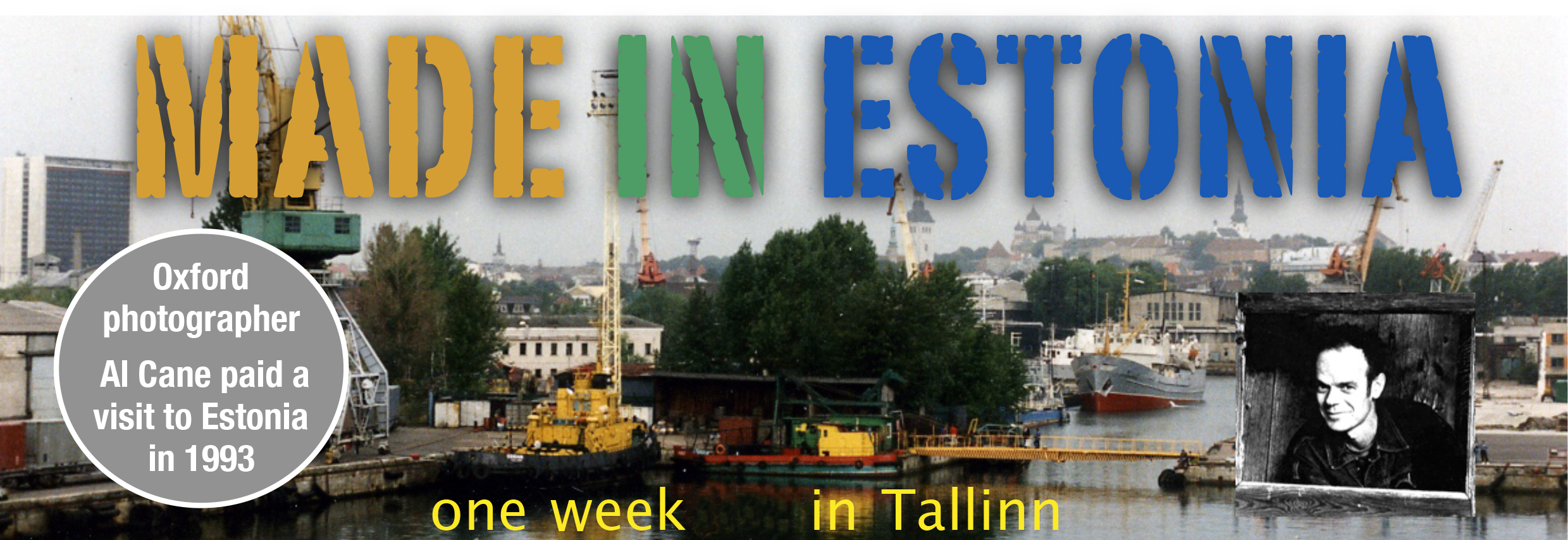
It was towards the end of the summer of 1993 and I was living just outside Oxford, close by Pear Tree Roundabout, at Frieze Farm, and cycled in daily to my job as a community arts worker on Cowley Road at Bloomin Arts. I was at the time involved in the ‘mail art’ scene, which was using the postal service to send themed art by invitation to exhibitions around the world, including the Netherlands to Germany, the USA and Estonia. From this I had developed a postal correspondence with Made Balbat, (pronounced Marday) an artist who lived in Tallinn, Estonia. She was an established artist and printmaker in her own country and taught art in a school. I had some time on my hands at the end of that summer and on an invitation decided to pay a visit to a country I knew very little about, except that two years previously it had become an independent country following the collapse of the Soviet Union and a peaceful singing revolution through the Baltic States.
Getting there was complicated – for at the time there were no direct flights to Tallinn. It involved catching a bus to London, a train to Felixstowe, an overnight ferry to Gothenburg in Sweden, followed by a bus journey across that country to Stockholm and then another overnight ferry to the capital city and port of Tallinn. The journey was long and was at times tedious. A radio, a cassette Walkman, a camera and many paperback novels kept me company on my solo journey.
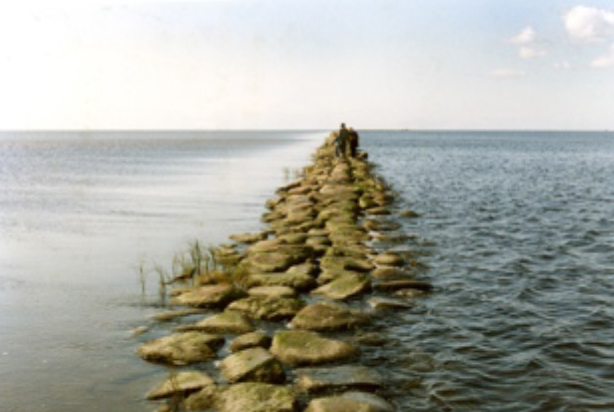
The MS Estonia was a huge cruise ship that had plied its trade across the Baltic for a dozen years. What was a really impressive sight was sailing through the Stockholm archipelago, to see dozens of small beautiful islands in a calm sea, some inhabited, others not, lit in the serene evening light. I took a dozen photographs or more but I never saw them, both prints and negatives were missing when a few weeks later I collected them from a print bureau in Norwich.
The next morning over the horizon the intriguing skyline of Tallinn’s harbour was visible on the horizon and getting ever nearer, I felt that an adventure was about to begin. My friend Made and her friend Meelis had arranged to meet me at dockside. It had been arranged for me to stay with Meelis, a psychotherapist who worked with alcoholics, later on I found out that he had insisted that I stay with him for the duration of my two weeks stay. He was the jealous type, not that he had anything to worry about.
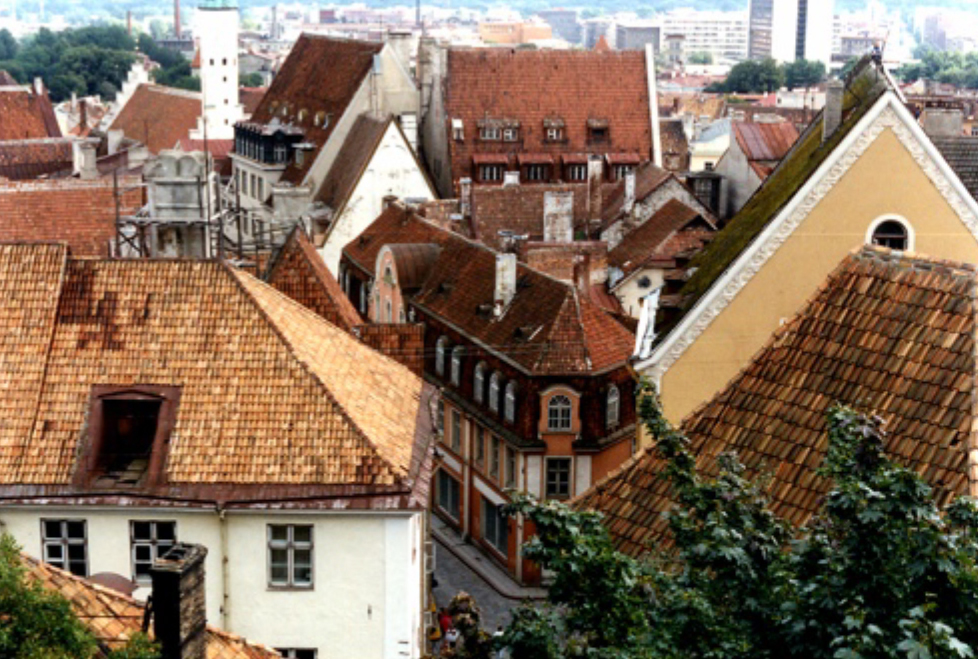
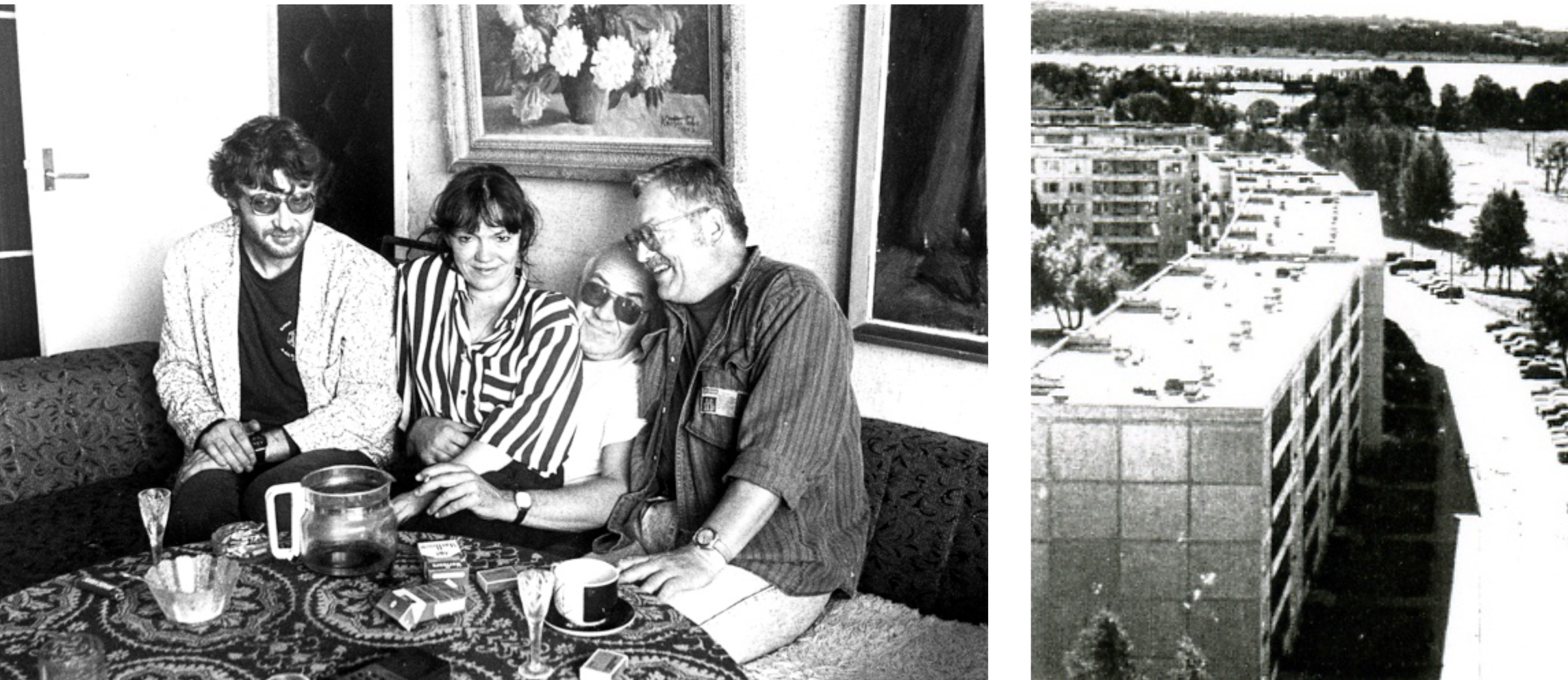
Tallinn has an very fine medieval town centre but seems to be surrounded by huge Soviet-style housing estates. We took a tram to Meelis’s apartment, which in fact was quite comfortable. We all arranged to meet up later that evening for a welcoming drink. Tallinn was full of cobbled streets, old town historical buildings, trendy bars and cafes, the tourists had started appearing, but there weren’t many yet.
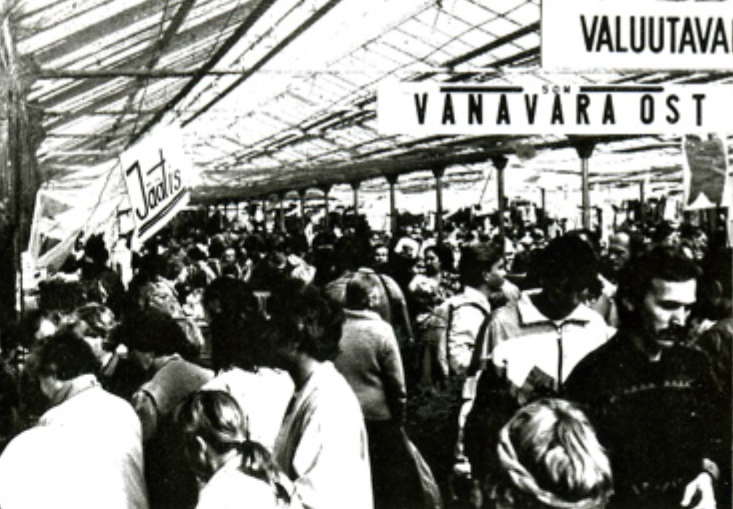
Meelis had suggested that we visit the huge Saturday flea market very close by the next day, but just before entering it he warned me against the likelihood of being pickpocketed. So I was wary and kept my cash stashed carefully. I bought a Russian monocular, like binoculars, but for one eye, which I still have. The ironic thing was that it was Meelis who had his wallet lifted that day.
Overcoming that mishap he took me took me to meet some friends, a family of well known Estonian actors. Not well known to me and of course the vodka flowed with toast after toast to whom or to what I didn’t know, Estonian not being a language I was familiar with at all. Stumbling out of there we landed in a nearby park. I was drunk at midday, but didn’t want to be, the vodka had taken its toll. There is a picture of people lying across railway lines acting quite stupidly. Somehow in these situations I seem able to keep on taking photographs, I remember sitting down in this park and falling asleep and waking up suddenly a bit later with the sound of rocks and stones landing close to me. I was being attacked by a group of Russians. I stood up and shouted at them in English and suddenly out of nowhere a police car appeared and two policemen jumped out and proceeded to lay into the Russians. I’m told that jaws were broken. The police bundled us into their car and gave us a lift out of the situation into central Tallinn. This was a small incident of the ethnic tension within the country for Russians and Estonians were not on good terms due to what had happened over the previous 50 years of Soviet occupation. It all got a bit blurry at this stage but we got safely back to the apartment, excitement over – or so I thought.
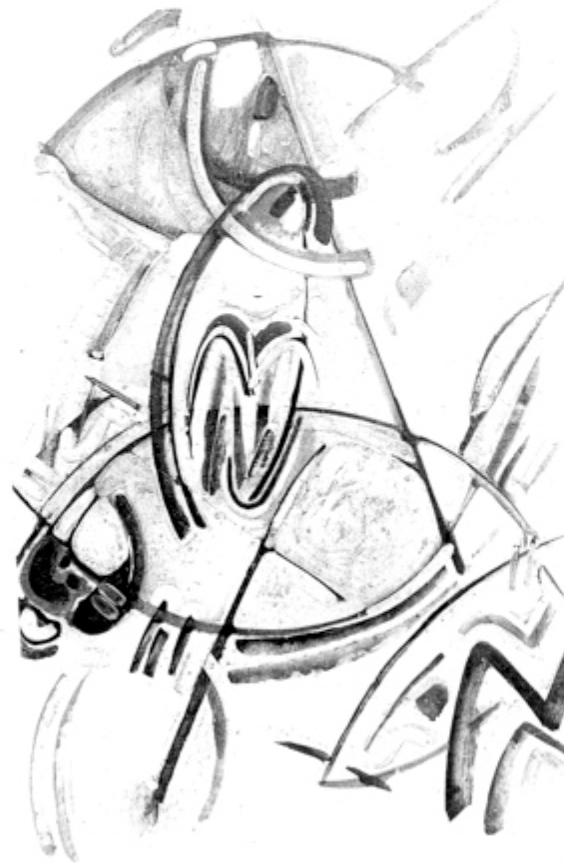
The following day, Sunday, looked promising with a trip into the town centre, to go to a cafe or two, meet people and hear some music. Meelis was around and we shared a few beers this time. At some point he went off to see somebody and I found myself on my own. I had been warned about taking care of myself in this town as this was still a lively place, even though it was Sunday afternoon. I noticed a particularly hard looking, heavily tattooed skinhead of about 40 sitting at a table. He caught my eye and beckoned me over and asked me to sit down, against my better judgement I did. It turned out that he was an artist, a painter and wanted to talk about art with me and show me his paintings. He clapped his hands and a lackey began to carry in quite large abstract canvases. They were well executed and presentable – completely at odds with the man’s appearance. But there was a threatening undertone to his words when he more or less commanded me to photograph his works, one by one. Sadly I didn’t have the courage to photograph him. Trying to tell him that I only had a black and white film in my camera fell on deaf ears, he had been drinking too. That done I managed to slip away to another part of Tallinn.
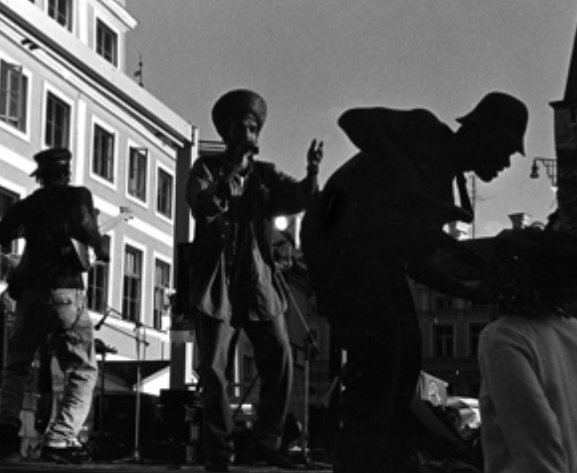
It was to the central square where the Jamaican reggae band called Iqulah and Gideon Force were setting up. I don’t think Estonians had ever seen or heard this music before. They were great, I loved hear this bouncing dub in the middle of an ancient market square with Estonians and a few visitors like myself joining in. After this I bumped into a group of young people who offered me a drink and chatted for a while. I remembered running around with them. Darkness was falling and I thought it was time to get back to Meelis’s apartment to recover.
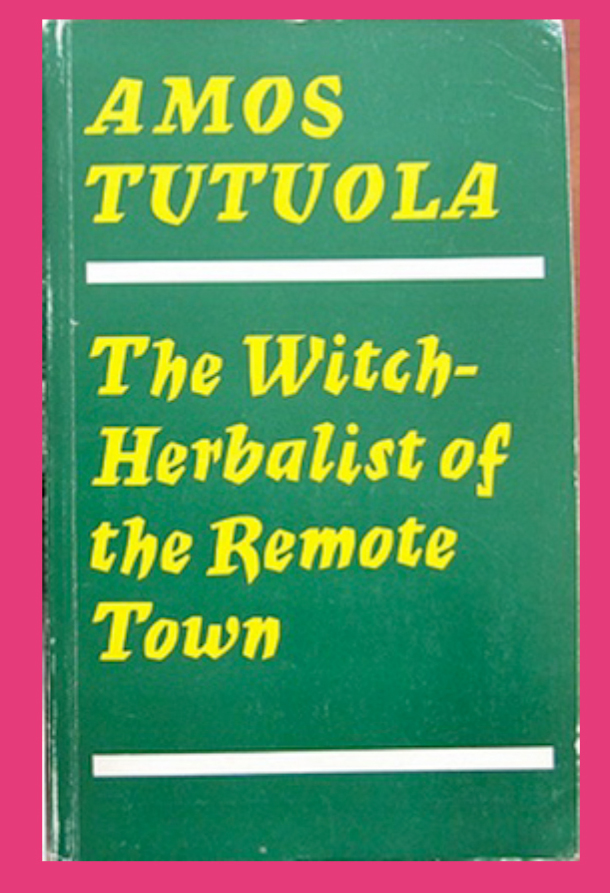
Bounding up the stairwell I found that my key didn’t work in the apartment’s door when I tried to turn it, which was weird. I went out for a walk to while away some time thinking that Meelis might return in the meantime. Minutes passed, nothing, my key definitely didn’t work. After banging on the door hard several times I went to a phone box and tried ringing him at home, still no answer, this was now getting strange. Resigned to sitting outside the door I pulled out the only book I had with me and read it by the light in the stairwell, which was exposed to the elements. It was a Nigerian novel by Amos Tutuola, ‘The Witch Herbalist of the Remote Town’, who also wrote the novel ‘My Life in the Bush of Ghosts’, whose title had been borrowed by David Byrne and Brian Eno for their musical collaboration in the 80s. This was an excellent story about a hunter who is trying to find a cure from a witch herbalist. It was such an entrancing and magical book that I was transported to another place. I read it cover to cover through the night, with breaks for walks about and occasional short sleeps. Without that book my night would have been much, much harder. Although it was August it was chilly and I didn’t have much clothing with me. People passed me on the stair and probably thought I was a drunk, I might as well have been.
Morning finally came and I tried the door again. Meelis answered it and said “Where have you been?” I nearly hit him, but restrained myself, it turns out he had passed out and was dead to the world when I knocked on the door and rang. He had left his key on the inside of the door.
I felt really rough and resolved to move out and stay elsewhere. I couldn’t stay with Made, she had two young sons in a tiny apartment out of town. I think she berated him for not looking after me. Relations between myself and Meelis were never that friendly again. But shortage of cash meant that I did stay the rest of the time with him. I think in his own way he tried to make amends.
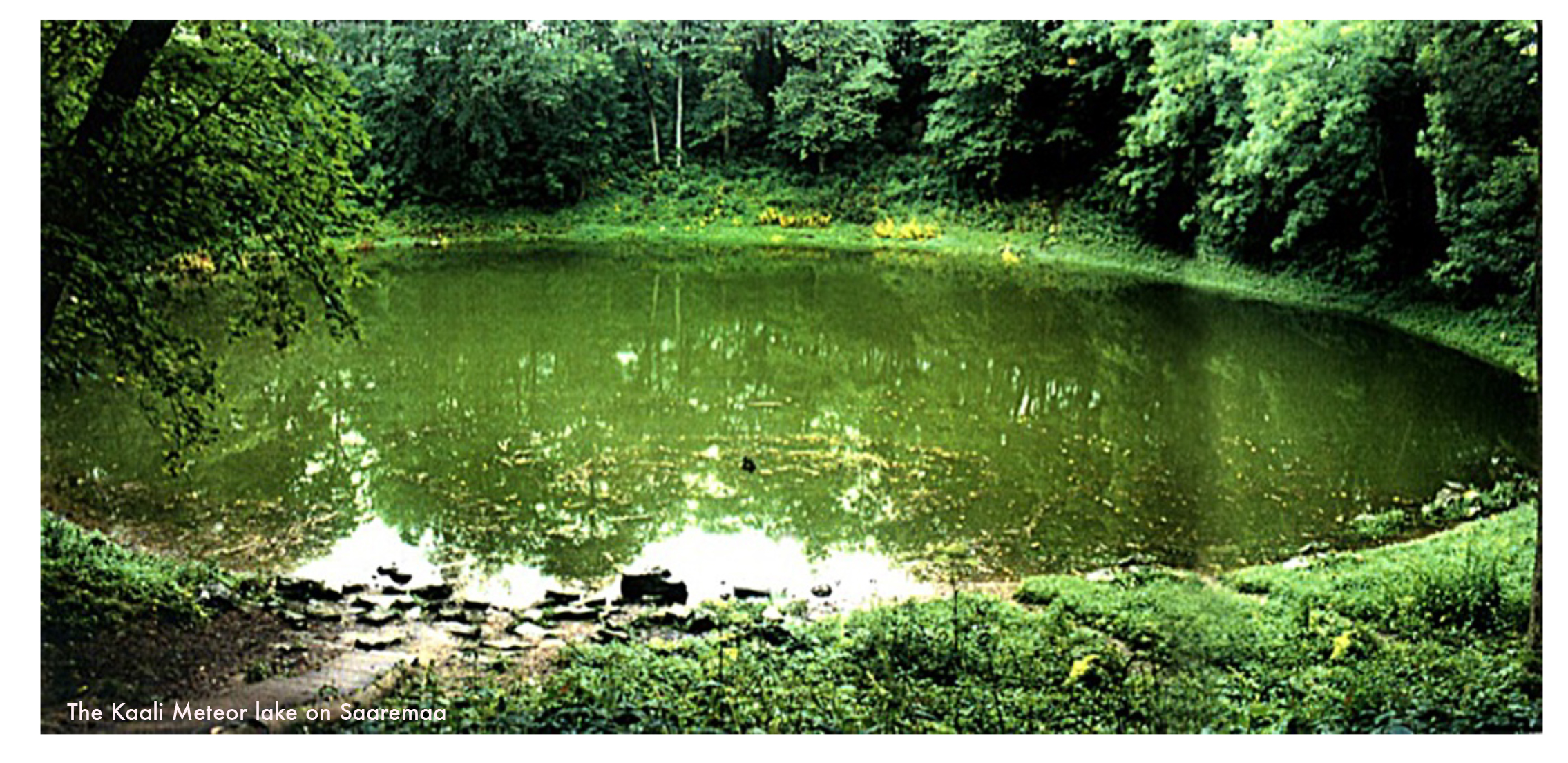
The rest of the trip was not as adventuresome, but I didn’t touch another drop of vodka, although I’m sure I had the occasional bottle of beer. An accidental meeting up with the German couple of mail artists that I had met previously in Oxford. There was an overnight railway trip to the seaside resort of Parnu, and a two day excursion to the western island of Saaremaa and the mysterious site of the Kaali meteorite and its crater lake. The journey home was comparatively uneventful, again on the MS Estonia*, back across Sweden to Gothenberg by bus (and by this time I was broke) and the return North Sea crossing to Felixstowe and a week of film-making at an arts centre in Norwich. Strange times.
* Exactly one year later the MS Estonia sank without obvious reason in the middle of the Baltic with the loss of over 800 lives.
I was three years old when my Mum lifted me up to peer through the small reinforced window in the door of the hospital ward. I found myself looking into a long white sterile room at the end of which were some very large clunky machines which were vaguely human shaped. I didn’t know what I was looking at until my Mum told me that it was my Dad who was inside one of those machines. She called it an Iron Lung, which meant nothing to me, for all I knew was that he was ‘very poorly’ and ill with a disease and that it was dangerous for me to go near him. This early memory has been etched in my memory ever since.
In his early thirties and in the late 1950s my Dad, John, worked in a cotton spinning factory in Rawtenstall, Lancashire. He had succumbed to an epidemic of polio that swept through the area at that time, not long before mass vaccinations came in and pushed this highly contagious disease back. Dad was absent for a few months making this a difficult time for our family. My Mum shielded my sister, Jane, and I from a lot of it, but it must have been a tough time for her. Eventually Dad returned home, battered and no longer able to usefully use his left arm, the muscles had withered to make his arm just hang there.
But he didn’t give up, he learnt to write again with his right hand and returned to his job for the time being and continued with his love of amateur dramatics, both acting and directing with the Haslingdon Arts Society. He also followed Bury FC through thick and mostly thin. His jazz drumming in a trio did come to an end though. I found out later that he was not happy with his situation and he took a bold decision to change both his life and that of our family for ever. The Lancashire cotton industry was in serious decline, everyone could see that and he sought an opportunity that arose to work in what was then the British colony of Southern Rhodesia, then part of the Federation of Rhodesia and Nyasaland. He was offered a manager’s job at a spinning and weaving factory in the Midlands in a small town then called Hartley. We followed my Dad there and landed in early 1960, it was a great shock to suddenly find myself in a tropical, dusty country with different looking people and strange animals and insects too.
The year was 1973, I was 18 and I had recently arrived in the UK from what was then Rhodesia, having narrowly escaped being called up for national service in that country to fight in an unwinnable war. I had spent most of the summer working at a timber yard near Farnham, Surrey, where my sister Jane, was at art school. It was a tough, macho world of work where I would witness much bullying and would return home exhausted, with splinters in my hands having taken lengths of wood off a huge saw all day without ear or hand protection. The house where I was living was a friendly one made up of various members of the Nissen family, who were half Danish. The mother was called Jenny and the daughters were Diana and Sarah and the youngest was Andrew, 17, and just leaving school. In a mad moment we all decided to go to Denmark for a sojourn at the end of the summer for the adventure to see Diana, who had recently had a baby son and had already moved to Roskilde.
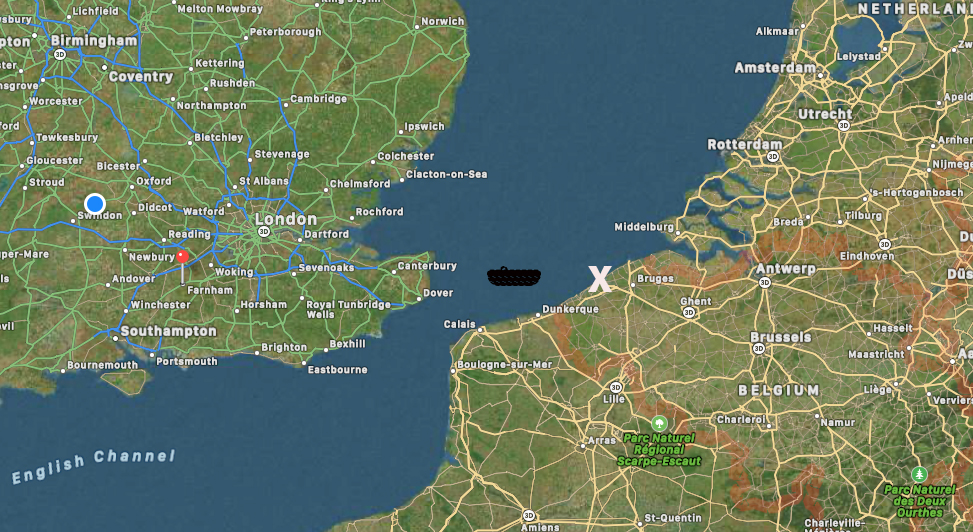
I teamed up with Andrew to go with. We decided it would be fun to hitchhike all the way to Denmark. (Andrew later on joined a religious order and became a monk.) Jane and Sarah went separately as we didn’t think four hitching together would work. We set off early one morning in late August and caught lifts mostly with trucks across Kent through to Dover. This was the easy bit. A four hour ferry trip across the North Sea to Ostend followed where if memory serves me well it was well past midnight when we arrived and not much was open. We had a tent between us and we scaled a wall and decided to pitch the tent in what looked like a municipal park, it was hard to see as it was unlit. Morning came and on peering out the door of the tent we realised that we were in the grounds of a royal palace and there were royal guards in uniforms around. (These days we might have been arrested for trespass or worse.) We were quickly noticed and marched off the premises by the guards and were on our merry way towards The Netherlands and Germany. But it wasn’t easy as we walked for what seemed like hours with a heavy backpack to get to the outskirts of Ostend without having much of a clue of where to go. More follows…









 Citizen Cane picks up his camera